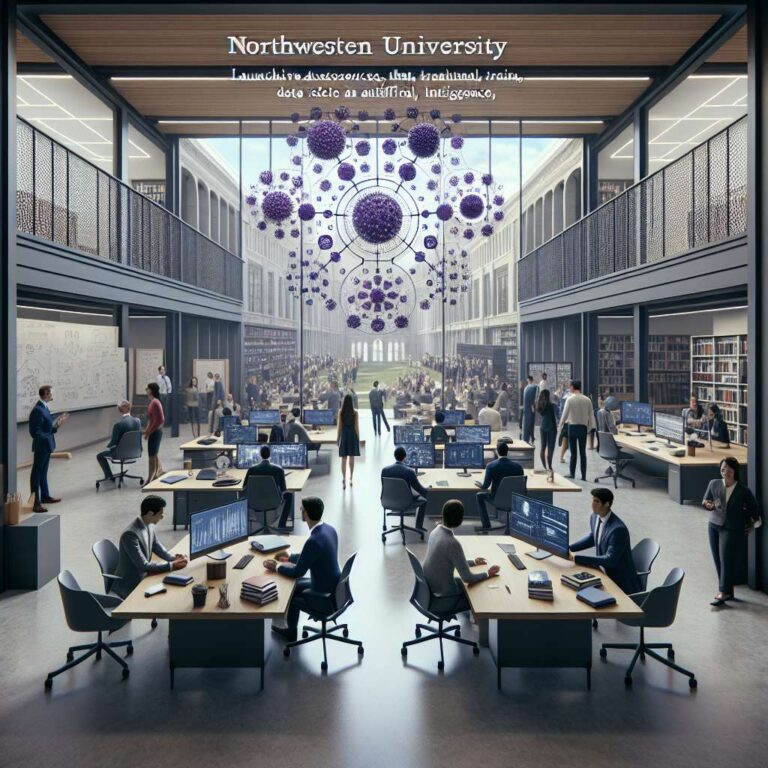
Northwestern University has established the Northwestern Network for Collaborative Intelligence (NNCI), a new institutional network dedicated to advancing data science and artificial intelligence capabilities across the full spectrum of the university’s research and educational activities. This initiative is designed to provide faculty and students at Northwestern with the tools, expertise, and opportunities needed to harness artificial intelligence in their academic and professional pursuits.
The NNCI’s mission goes beyond campus boundaries, aiming to create an ecosystem where collaboration flourishes not only among internal experts but also with external partners such as corporate, government, and nonprofit organizations. By acting as a central hub within the Office of the Provost, NNCI seeks to enable dynamic, cross-disciplinary projects that leverage artificial intelligence for practical, real-world solutions. The network will also ensure that all Northwestern students have access to foundational education in both data science and artificial intelligence, addressing the evolving requirements of today’s job marketplace and empowering the next generation of innovators.
This network arises from efforts by the Data Science and Artificial Intelligence Steering Committee, which engaged in a year-long process to determine the most effective strategies for university-wide support in these rapidly evolving fields. NNCI will be led by co-directors Abel Kho, a leader in health data innovation from the Feinberg School of Medicine and founding director of the Institute for Artificial Intelligence in Medicine, and V.S. Subrahmanian, a renowned computer scientist recognized for his work in security and artificial intelligence applications, and the founding director of Northwestern’s Security and AI Lab. The pair will guide NNCI in its support for both research initiatives and curricular efforts, ensuring adaptability so new programs and research centers can connect and benefit from the shared resources of the central hub.
Starting in the summer and continuing into the fall, NNCI is slated to anchor events for the Northwestern community aimed at exploring the influence of artificial intelligence across disciplines, as well as champion experiential learning opportunities for students. University leaders believe this effort positions Northwestern as a potential global frontrunner in data science and artificial intelligence-driven research and training. By fostering collaboration and innovation, the NNCI is poised to influence not just academic excellence at Northwestern but also broader impacts in sectors reliant on cutting-edge data science and artificial intelligence.