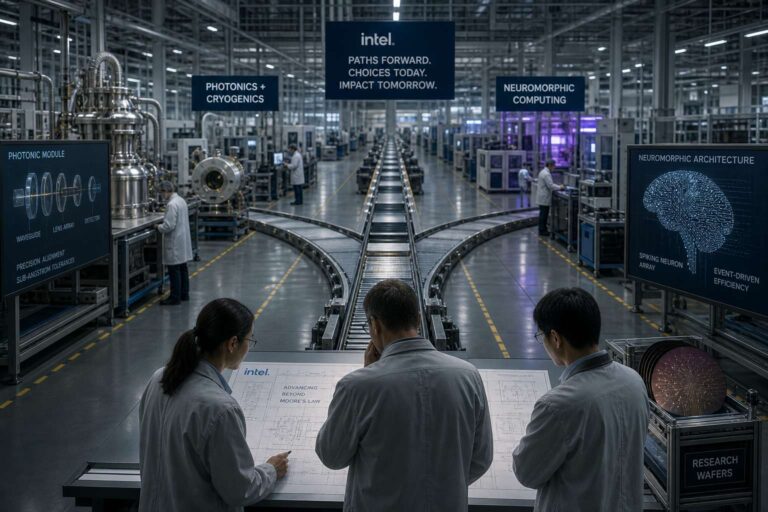
Intel is looking past the current Artificial Intelligence hardware boom and placing a longer-term wager on quantum processors and neuromorphic chips. CEO Lip-Bu Tan has named company veteran Pushkar Ranade as chief technology officer to lead work in quantum computing, neuromorphic computing, photonics, and novel materials. Analysts described the move as a bet on future computing models rather than something that will materially change Intel’s product position in the near term.
Intel’s quantum effort remains relatively opaque. The company’s most recent quantum chip, Tunnel Falls, was announced back in 2023. Analysts said the quantum group has faced limited funding and resources, along with staff turnover, though leadership continuity remains in place through quantum hardware leader James Clarke and quantum systems and software leader Anne Matsuura. Some see Ranade’s appointment as a sign that Tan may want to reorient Intel’s focus and investment in quantum computing.
Competition is intense, and Intel is seen as trailing companies with more public and mature quantum plans. IBM is viewed as particularly far ahead, with a cloud quantum offering already available and a multi-year roadmap that analysts say has been executed consistently. Intel Capital recently invested ? million in quantum processor company QuantWare, though that does not necessarily indicate Intel will adopt the company’s technology. Analysts urged enterprises to take a measured view of the pivot and to treat emerging technology claims cautiously.
Quantum systems are expected to complement, not replace, conventional computing hardware. The hardware stack will likely look like a combination of CPU, GPU, and quantum computing chips in a datacenter, not just a quantum processor working on its own. That view aligns with a broader industry shift among large technology companies toward hybrid architectures. Quantum processors and Artificial Intelligence supercomputers were also described as naturally complementary, with quantum machines handling physics that classical systems struggle to emulate while GPUs provide scale and throughput for control and learning.
Intel’s strongest advantage may be manufacturing. Analysts said its CMOS spin qubit approach could allow large-scale production, and they pointed to Intel’s ability to manufacture reliably at volume. Ranade’s background in manufacturing roles was also seen as a signal that foundry operations remain central to Intel’s future. Neuromorphic computing was described as an area where Intel’s development work is especially strong, reinforcing the company’s strategy of pursuing differentiated technologies beyond the current Artificial Intelligence chip market.