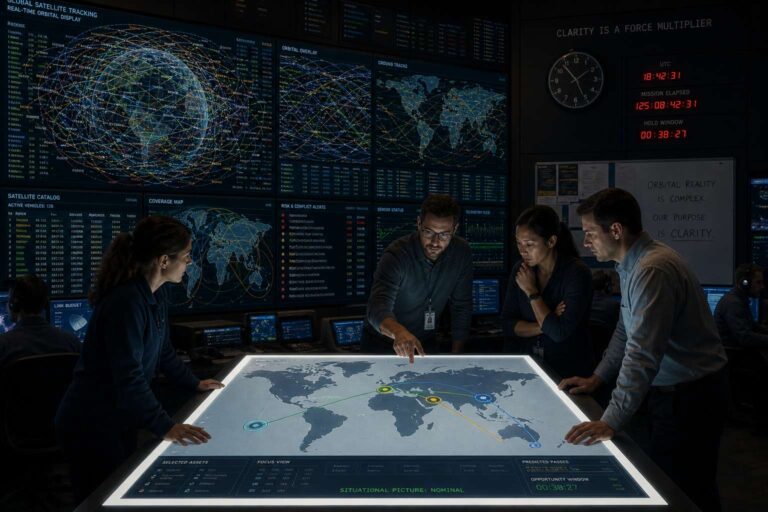
Artificial Intelligence is becoming central to how the National Reconnaissance Office delivers space-based capabilities tied to national security. NRO Director Chris Scolese said the agency must keep using Artificial Intelligence and other emerging technologies to preserve the U.S. space-based intelligence advantage, protect satellites, improve monitoring of adversary activity, and deliver timely, accurate intelligence to warfighters, analysts, first responders, and decision makers.
Throughout its nearly 65-year history, the NRO has focused on applying advanced technologies in space and on the ground to create new capabilities, improve resiliency, and give users a better experience. Over the last several years, the NRO has been undergoing a major transformation, improving the accuracy and speed of its collections through the proliferation and diversification of its systems, including adding more than 200 satellites of diverse sizes and capabilities. That expansion is expected to push beyond what human operators can effectively manage on their own, making broader use of Artificial Intelligence increasingly important to operations.
The agency is using Artificial Intelligence to increase autonomy on spacecraft, support on-board processing, and enable real-time recognition for situational response. It is also being applied to simplify tasking and optimize mission planning across the constellation, turning what had been a complex process into a more conversational one. In addition, Artificial Intelligence is being used to improve the discoverability of data and make information easier for users to understand, including in high-pressure situations.
Trust and transparency are being treated as core requirements as these systems move into wider use. Scolese said the NRO is emphasizing rigorous testing and validation, continuous monitoring for performance issues, and clear documentation showing how each system was developed. He also stressed the need to look inside the black box of Artificial Intelligence so the agency can verify that model predictions and outputs are correct and understand how those results were produced, a step he described as essential to maintaining trust in NRO data.
Scolese said the shift does not signal an effort to replace people with machines. Instead, he framed workforce development as a priority, with Artificial Intelligence being integrated across satellite systems, ground systems, and mission portfolios to help NRO teams and partners work better and faster.