
Bleeding Llama exposes security risks in local Artificial Intelligence infrastructure

A critical flaw in Ollama has exposed how self-hosted Artificial Intelligence systems can leak prompts, credentials, and private data when deployed with weak defaults. The disclosure underscores that local inference is now production infrastructure and needs the same security controls as any other exposed service.
Europe firms struggle to track Artificial Intelligence cyberattacks

European organisations are adopting Artificial Intelligence widely, but many lack the visibility and governance needed to understand whether they have already been targeted by Artificial Intelligence-powered attacks. ISACA’s latest survey points to rising concern over misinformation, privacy, weak policy controls, and a growing skills gap.
Artificial Intelligence reshapes NRO space operations

The National Reconnaissance Office is expanding Artificial Intelligence across satellite and ground systems to speed delivery, improve accuracy, and extend human capabilities. The agency is pairing that push with testing, validation, and workforce development aimed at building trust in mission-critical systems.
PCIe 8.0 targets 1 TB/s bandwidth with possible connector change

PCI-SIG has advanced the PCIe 8.0 draft to version 0.5 while signaling that a new connector may be needed to handle the standard’s higher throughput. The shift highlights growing pressure on the current copper-based PCIe slot as bandwidth targets climb.
Intel bets on quantum and neuromorphic computing
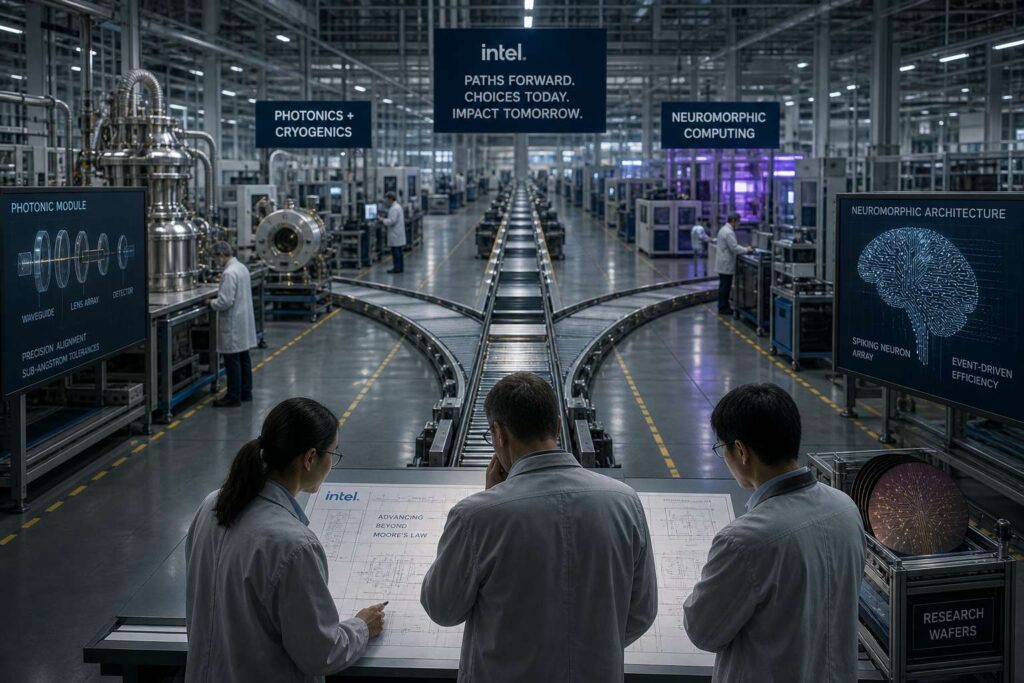
Intel is shifting attention beyond the current Artificial Intelligence chip race by reinforcing work on quantum, neuromorphic, photonics, and other long-term computing technologies. The move signals a broader strategy tied to manufacturing strengths, even as rivals remain further ahead in quantum commercialization.
Genesis mission ties Artificial Intelligence progress to U.S. energy buildout

U.S. Energy Secretary Chris Wright and NVIDIA’s Ian Buck framed energy capacity and computing infrastructure as twin requirements for American leadership in Artificial Intelligence. The Department of Energy’s Genesis Mission is positioned as the practical effort to apply Artificial Intelligence to science, grid modernization, and fusion research.
Ibm expands enterprise Artificial Intelligence for hybrid cloud and mainframes

Ibm introduced new enterprise Artificial Intelligence products centered on hybrid infrastructure, mainframes and agent orchestration. The updates reinforce its multi-model strategy while targeting regulated and on-premises environments where business data remains entrenched.
Artificial Intelligence diffusion lags frontier gains

Rapid advances in Artificial Intelligence capability are not translating automatically into broad productivity growth or equitable gains. Diffusion remains uneven across firms, sectors, countries, and workers, pushing policymakers to focus on skills, governance, procurement, and measurement.