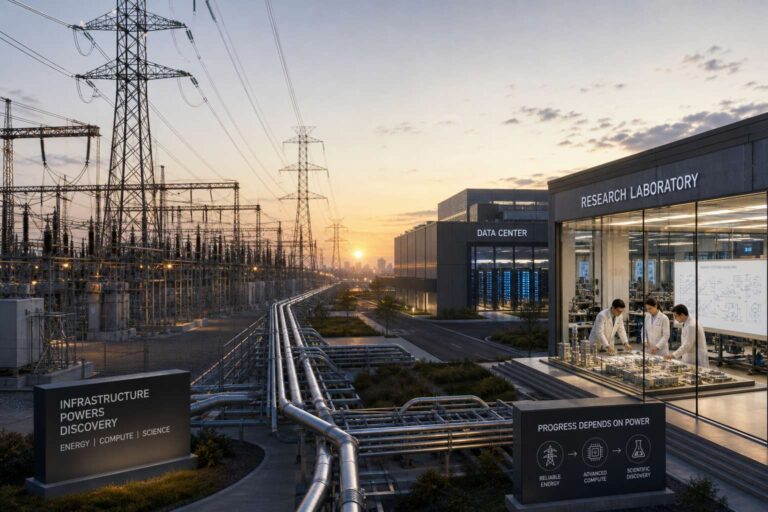
U.S. Energy Secretary Chris Wright and NVIDIA Vice President of Hyperscale and High-Performance Computing Ian Buck cast American leadership in Artificial Intelligence as inseparable from American leadership in energy. At the SCSP Artificial Intelligence+ Expo, they argued that abundant, affordable electricity is foundational to scientific progress, economic opportunity, and the next phase of Artificial Intelligence development. The Department of Energy’s Genesis Mission sits at the center of that strategy, using Artificial Intelligence to accelerate scientific discovery through collaboration between the federal lab system and industry.
The DOE brings 17 national labs, scientists, national problems, and data, while NVIDIA contributes chips, algorithms, methods, and long-standing lab partnerships. NVIDIA and the DOE are building two Artificial Intelligence supercomputers together at Argonne National Laboratory. The first, Equinox, is being stood up now with 10,000 NVIDIA Grace Blackwell GPUs. The second, Solstice, will use 100,000 GPUs with NVIDIA Vera Rubin. “To put that 100,000 in perspective on the next-generation GPU, which is dedicated to science, it’s 5,000 exaflops,” Buck said. “That’s a big number that actually is five times larger than the entire TOP500 supercomputer list combined.” Buck also described an open source NVIDIA Artificial Intelligence model trained on 1.5 million physics papers, then fine-tuned on 100,000 papers specifically about fusion, creating a specialized agent for DOE researchers.
Wright said the U.S. energy challenge is increasingly about electricity. Over the last 20 years, Wright said, the U.S. has tripled oil production and doubled natural gas production, but electricity production has barely grown. He said the department is leaning into natural gas, nuclear, and coal, and pointed to small modular reactors as a near-term tool. On nuclear, Wright pointed to small modular reactors as a near-term lever, and said three small modular reactors (SMRs) will go critical by July 4 of this year. He also said fusion programs are being intensified by the computing power and insights Artificial Intelligence now provides.
Buck linked the energy conversation to chip efficiency, saying NVIDIA’s hardware advances are improving output per unit of power. “We went from the Hopper generation to Blackwell,” Buck said. “We increased performance by 30x. We actually increased performance per watt by 25 times.” Wright added that Artificial Intelligence can also help remove bottlenecks in grid interconnection studies that currently take years. He said success for Genesis within 12 months should be visible in fusion, materials, and grid interconnection, with concrete deliverables that were previously out of reach. Both men framed larger electrical generation and data center buildout as a way to strengthen the grid and expand the benefits of Artificial Intelligence-driven science.