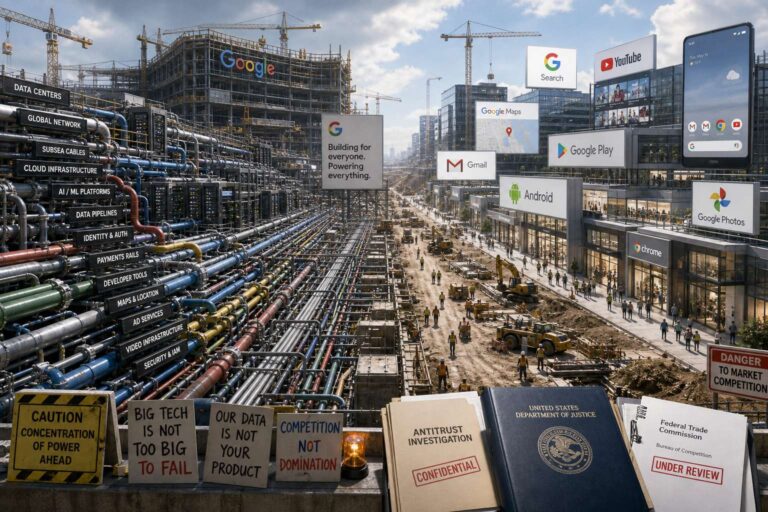
Google is accelerating its Artificial Intelligence strategy across infrastructure, enterprise software, developer tools, and consumer products. AI Weekly says 44 AI Weekly issues and 93 live stories from the last 30 days mention Google. The company used Cloud Next in April to bifurcate its accelerator roadmap, introducing TPU 8t for training and TPU 8i for inference, with the inference chip claiming 80% better perf-per-dollar on chain-of-thought MoE serving. Sundar Pichai also disclosed that 75% of new code at Google is AI-generated and engineer-approved, up from 50% last fall and ~30% a year ago.
Google tied that infrastructure push to a broader enterprise platform expansion. The same week brought a ?B investment in Anthropic, the launch of the Gemini Enterprise Agent Platform with native plug-ins from Adobe, Atlassian, Salesforce, ServiceNow and Workday, and confirmation that the next Apple Siri will be powered by Gemini. Other listed moves include Deep Research and Deep Research Max in the Gemini API, Workspace Intelligence across Gmail, Drive, and Calendar, Gemma 4 open-source models under Apache 2.0, and TorchTPU for running PyTorch natively on TPUs at scale. Google Cloud also committed ?M to accelerate partners’ agentic Artificial Intelligence development and expanded its supercomputing work with Nvidia.
The live story tracker also shows Google broadening Gemini across search, Android, health, media, and security. Recent items include agentic Gemini features in Android 17, Gemini Omni video appearing in the app before I/O 2026, a conversational Ask YouTube experiment for Premium users, and a Gemini-powered health coach tied to a Fitbit rebrand. In enterprise and security, Google launched Artificial Intelligence fraud defense, expanded Gemini API file search to multimodal RAG across images, PDFs, audio, and text, and released multi-token prediction drafters for Gemma 4 that deliver up to 3x inference speedup. The tracker also points to product risks and governance pressure, including reports about Chrome privacy wording, on-device Gemini Nano installation complaints, a critical CVSS 10.0 Gemini CLI flaw, and litigation tied to an inaccurate AI Overview.
Beyond products, Google is operating under rising political, labor, and regulatory pressure as its Artificial Intelligence footprint grows. The feed highlights classified Pentagon-related work, internal employee protests, and a vote in which Google DeepMind UK workers backed unionization by 98%. Regulatory scrutiny is also visible in Europe, where proposals would force Google to open Android to rival Artificial Intelligence assistants under the Digital Markets Act. Financially, the company is presented as spending and investing at enormous scale, with reports citing Alphabet Q1 revenue of ?.9B, Google Cloud revenue of ?B, capex guidance raised to ?B, a planned ?B Artificial Intelligence hub in India, and estimates that Google controls ~25% of global Artificial Intelligence compute with 3.8M TPUs and 1.3M GPUs.