
The artificial intelligence hype index: data centers’ neighbors are pivoting to power blackouts

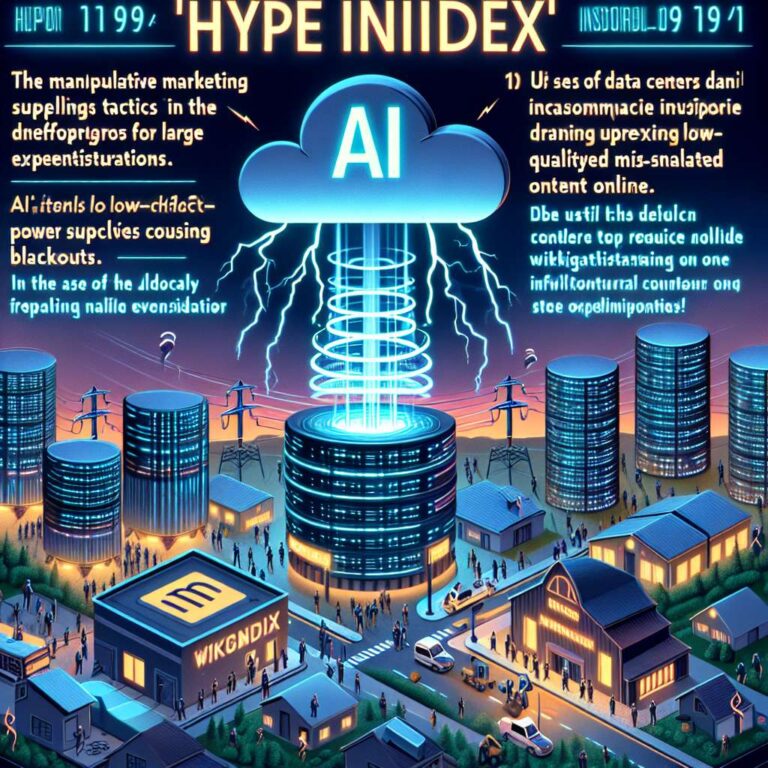
The artificial intelligence hype index highlights a widening gap between corporate promises and practical outcomes as many firms pivot to the technology without clear aims. New data center construction is creating local power blackouts and water shortages that have prompted community pushback.

The Artificial Intelligence Hype Index aims to separate marketing from reality in a market where almost every business appears to be pivoting to Artificial Intelligence. The article says many companies are adopting the technology without a clear understanding of its role, using convenient buzzwords such as ‘Optimization’, ‘scaling’, and ‘maximizing efficiency’ to justify investment. For many customers of Artificial Intelligence companies the large amounts of money being spent are not producing clear returns, and the index suggests those expenditures may never add up to the promised benefits.

This month the coverage of the sector did not improve the technology’s standing. The piece highlights several problematic uses of Artificial Intelligence, noting that a group of non governmental organizations and aid agencies used Artificial Intelligence models to generate images of fake suffering people to influence Instagram followers. It also reports that Artificial Intelligence translators are producing low quality Wikipedia pages in languages most vulnerable to extinction, a practice that risks degrading information in those communities rather than preserving it.

The article further documents the local infrastructure consequences of rapid data center construction. New Artificial Intelligence data centers are linked to power blackouts and water shortages for nearby neighborhoods, forcing residents to mount their own responses and ‘pivot’ away from the promised efficiencies. The combination of misleading corporate narratives, harmful applications of Artificial Intelligence, and tangible local disruptions frames the Hype Index’s conclusion that the current wave of investment and expansion is producing mixed and sometimes damaging results.
56

Impact Score

AMD claims EPYC lead in agentic Artificial Intelligence workloads

AMD is using rack-level benchmarks to argue EPYC CPUs will remain central to agentic Artificial Intelligence infrastructure. The claims target Nvidia’s Vera platform and Intel’s Xeon lineup as data centers rebalance around CPU-heavy orchestration work.

Hades variant affects 23 PyPI package versions

The Mini Shai-Hulud Hades variant is targeting PyPI packages tied to bioinformatics and Artificial Intelligence themes. Socket researchers say the malware uses Python startup hooks and compiled extensions to run a JavaScript stealer.

DiffusionGemma rethinks text generation with diffusion

DiffusionGemma applies diffusion-style denoising to text, trading autoregressive token-by-token decoding for iterative canvas refinement. Its design combines encoder guidance, bidirectional denoising, scheduling, and entropy-based sampling.

NVIDIA shows RTX Spark platform at Computex 2026

NVIDIA presented RTX Spark in Taipei as a Windows on Arm platform spanning gaming, creator, and Artificial Intelligence workloads. Microsoft also detailed Windows 11 optimizations built specifically for the new NVIDIA silicon.

Contact Us

Got questions? Use the form to contact us.

Contact Form

Clicking next sends a verification code to your email. After verifying, you can enter your message.