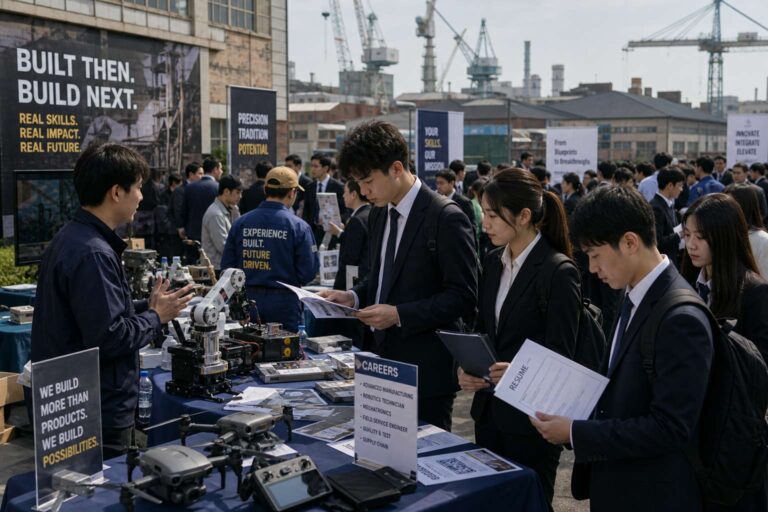
China’s technology boom is creating new jobs across areas such as drones, robotics, optoelectronics and embodied Artificial Intelligence, drawing strong interest from young workers. In Shenzhen, drone route planner Xue Haoran maps terrain and designs low-altitude logistics routes for SF Express, reflecting how new technologies are generating occupations that barely existed before. In Beijing, humanoid robot data collector Qu Hongtao described the work as creative and future-facing, combining algorithmic requirements with concrete data collection.
According to an analysis of spring recruitment data released by governments and organizations, job postings in robotics and advanced materials in China rose by over 30 percent year on year in the first quarter of 2026, while those in optoelectronics and Artificial Intelligence-related industries increased by nearly 20 percent. Creative work is also changing quickly. Jade Wu, an AIGC artist, said Chinese Artificial Intelligence video tools advanced significantly in 2024, helping him complete a promotional video for a major gaming IP in just one week. He said about 70 to 80 percent of the work is now done by Artificial Intelligence, leaving him to focus more on ideas and final presentation.
According to the Ministry of Human Resources and Social Security, of the 72 new occupations identified by the country over the past five years, more than 20 are tied directly to Artificial Intelligence. Each new occupation is expected to generate jobs for 300,000 to 500,000 people in its early stages. Meanwhile, China’s Artificial Intelligence core industry is approaching a scale of 600 billion yuan (around 85.58 billion U.S. dollars), according to Ding Zhuang of Renmin University of China. In Beijing, a high-tech job fair this March attracted more than 300,000 job seekers online and offline, underlining strong demand for tech talent.
Policy support is reinforcing that shift. In August 2025, China issued guidelines for the “Artificial Intelligence Plus” initiative to expand use of the technology in job creation and industrial upgrading. According to an action plan released by Chinese authorities earlier last month, China expects to fully integrate Artificial Intelligence into its education system and significantly boost both the scale and quality of Artificial Intelligence talent training by 2030. In 2026, China will subsidize vocational training for more than 10 million people, targeting fast-growing sectors such as the low-altitude economy, new energy vehicles and Artificial Intelligence.
The transformation is spreading into established industries as well. Road maintenance workers in Qinghai have learned to operate inspection drones, and pipeline maintenance in Taiyuan now uses sensors and inspection robots. At a steel manufacturer in Liaoning Province, engineer Ma Zhigang said he learned to write code and completed more than 60 intelligent upgrade projects with his team. China also approved a long-term national development plan this March that outlined more than 100 major projects for the next five years, pointing to another wave of employment opportunities as technology continues to reshape work.