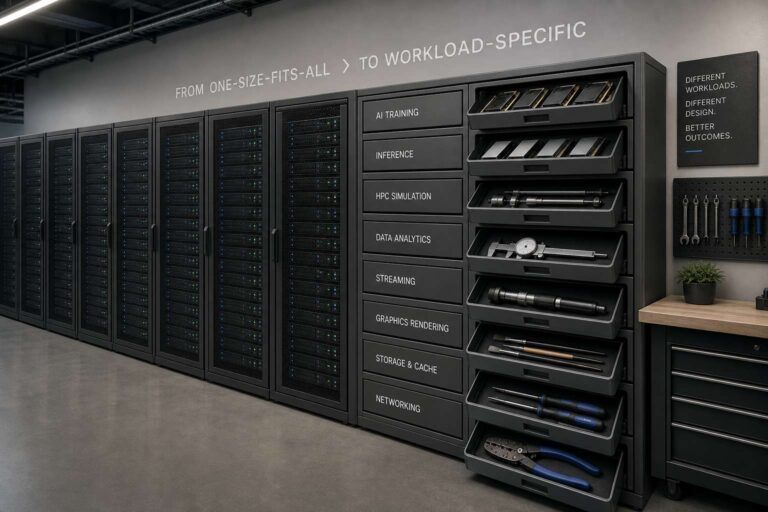
AMD is expanding its EPYC server CPU lineup into more specialized categories as customer demand shifts toward processors tuned for specific workloads. During the latest Q1 earnings call, CEO Dr. Lisa Su indicated that future EPYC generations will target different customer needs rather than relying on a more uniform product stack. Planned segments include dedicated EPYC SKUs for agentic Artificial Intelligence, hpc workloads, Artificial Intelligence training and inference, and cloud deployments.
This move will extend beyond the Venice platform, which is expected to launch this year. At CES 2026, AMD confirmed that EPYC Venice will be a highly dense CPU package with up to 256 cores and 512 threads of Zen 6c cores, while the regular Zen 6 configuration will have a maximum of 96 cores and 192 threads. The approach signals a broader shift toward tailoring server processors around distinct infrastructure and compute requirements.
Within the Zen 6 generation, AMD is expected to position Venice as a broad offering while pairing it with Verano, a related CPU line optimized for Artificial Intelligence infrastructure. Verano appears to use the same Zen 6 microarchitecture and is now identified as part of the 6th-generation EPYC CPU family, rather than a separate Zen 7-based design. That places AMD’s workload-specific CPU customization on the roadmap as early as this year.
One market projection in the source is incomplete and cannot be stated reliably. The source does state that server CPUs are also expected to grow at a 35% compound annual growth rate, highlighting why AMD sees room for more segmented EPYC products in a mature but expanding server market.