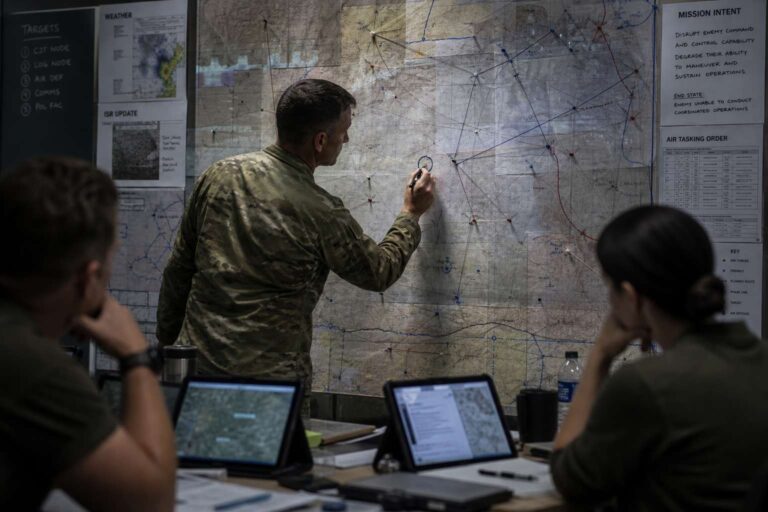
Matzpen, the IDF unit responsible for integrating and relaying Artificial Intelligence and big data across the military, played a central role in improving air force operations during the recent war with Iran, according to its commander, Col. Rotem Beshi. A system known as LOCHEM handled planning for attacks on Iran and worked closely with the air force’s Iran unit. Beshi said the unit’s digital applications and processes helped determine priorities and integrate planning for whole waves of attacks.
Beshi, 38, said gathering certain data for operational decisions, which once took days, can now be done in hours, or in some cases, minutes. He said the military is pushing to reduce nearly all processes tied to emergent situations down to minutes. The acceleration was supported by a brigade-sized IDF unit announced in December to expand the military’s use of Artificial Intelligence, including within Matzpen. Beshi said the unit works across major commands and helps connect intelligence, operations, planning, approval, execution, and battle damage assessment into a more unified process.
Beshi was asked about the new system’s effect on target prioritization for the 2,600 Iranian military-industrial targets and 2,200 regime-strength targets, but declined to discuss the numbers further for operational security reasons. He instead described a system that enables faster integration of targets into broader attack plans and supports rapid plan changes during combat on the Iranian and Lebanese fronts. He said Matzpen’s data streaming helped adjust aircraft trajectories and maintain operational flexibility. He also said there was a shared data picture with the US to fully exploit the information during joint coordination.
The unit also expanded the IDF Home Front Command’s ability to issue faster and more precise warnings. Beshi said that in the months between the June 2025 Iran war and the 2026 war, the home front command and Matzpen overhauled processes for identifying the coordinates of incoming Iranian attacks and sharing that data with police, Magen David Adom, and civilians. Matzpen also developed tools to track force locations and coordinate local security teams. Beshi said research with other IDF branches helped shrink the warning polygon for missile threats. Initial warnings at the start of the war covered a polygon of two million people, but eventually this was reduced to 900,000 people, and, in some cases, even fewer.
On the Lebanese front, Matzpen helped analyze threats from rockets, anti-tank missiles, drones, and human-reported video. Beshi said the unit used complex algorithms to send targeted warnings only to the forces under clear threat, limiting disruption to other units. He said that in late March, after a Hezbollah fighter launched an anti-tank missile toward IDF troops in southern Lebanon, a Matzpen application warned those forces within two seconds. Beshi said the warning gave them enough time to take cover and that no one was harmed. He described the broader effort as part of a major revitalization in how the IDF manages data, media, and Artificial Intelligence for operations.