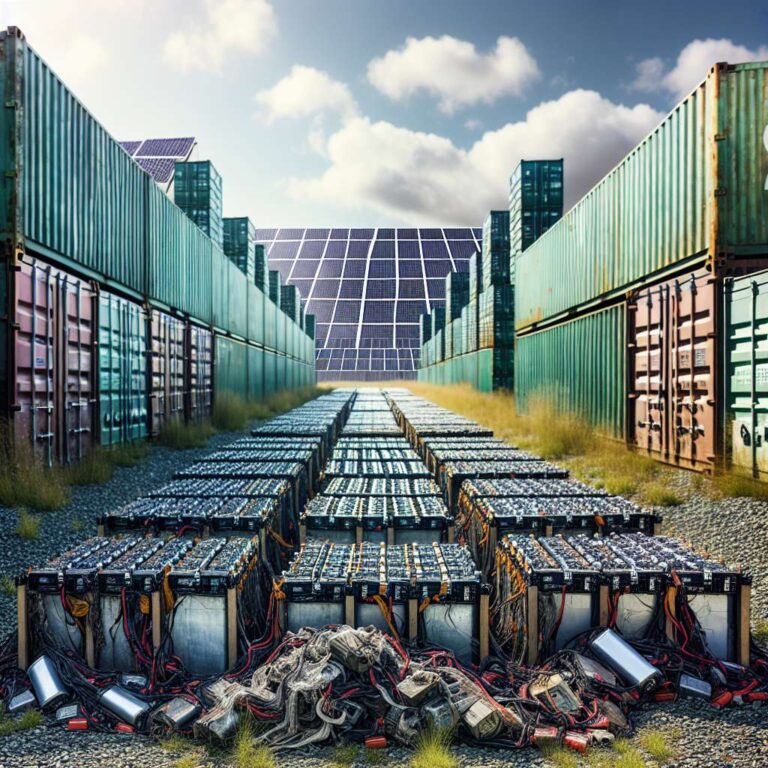
Redwood Materials, a leading battery recycling firm in the US, has introduced a new business division, Redwood Energy, which repurposes electric vehicle battery packs with substantial remaining capacity into renewable-powered microgrids. These microgrids are capable of operating on or off the main grid and are designed to provide power for data centers and other operations. The company´s inaugural system, revealed at its headquarters near Reno, Nevada, harnesses a combination of second-life EV batteries and solar panels to generate 64 megawatt-hours of electricity, positioning it among the largest such installations in the country.
The initial customer for this microgrid is Crusoe, a cryptocurrency mining company that has pivoted toward building and operating data centers for artificial intelligence workloads. Crusoe’s new facility, powered by the Redwood microgrid, utilizes 2,000 GPUs to process artificial intelligence queries. While this setup is small compared to major data centers, Crusoe has ambitious expansion plans, including a new artificial intelligence data center in Texas anticipated to house 100,000 GPUs. Redwood’s approach not only slows the consumption of new grid resources amid soaring demand but also offers a cost-effective and lower-emissions alternative by using batteries already removed from vehicles.
Redwood’s microgrids are suited for the increasing energy needs of artificial intelligence data centers, whose power requirements are expected to double by 2030. These microgrids can be implemented more rapidly than traditional grid expansion or fossil-fuel-based power plants, and their modular design allows seamless scaling. The technology utilizes a rigorous vetting process for each battery, integrating those with viable remaining lifespan into storage systems tied to renewable sources like solar and wind. As batteries eventually lose utility, they are cycled back into Redwood’s established recycling process. According to the company, there are already enough reusable batteries available to build microgrids that collectively could deliver a gigawatt-hour of storage, with plans for even larger systems underway. Industry experts suggest such solutions are critical for cutting climate emissions and providing scalable, sustainable power for the exploding artificial intelligence sector, with Redwood’s innovation potentially serving as a model for future developments in clean energy infrastructure.