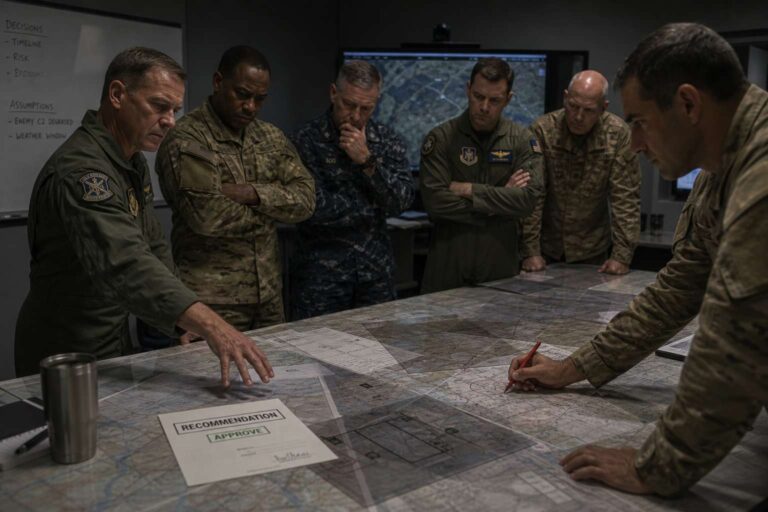
The Trump administration is pressing to expand Artificial Intelligence across the U.S. military, framing the technology as a strategic advantage and resisting limits that could slow deployment. Defense Secretary Pete Hegseth has argued that the Pentagon should be able to use Artificial Intelligence in any lawful military application, while President Donald Trump said he did not want new rules to weaken the country’s lead over China and other rivals.
Some military leaders are urging more restraint as the Pentagon moves ahead. Adm. Frank Bradley, head of U.S. Special Operations Command, said troops “have to be very careful about how we come to (Artificial Intelligence’s) employment and its inspiration into the delivery of lethality.” Bradley said he can see a future where Artificial Intelligence determines what targets to hit, but added that humans must be confident it “is going to deliver violence only where we intend it to be delivered.” Other Special Operations Command officials described Artificial Intelligence in less direct combat terms, with Sgt. Maj. Andrew Krogman and acquisition official Melissa Johnson emphasizing administrative support, modernization, and reducing cognitive workload rather than replacing operator judgment.
The Pentagon says its current focus is on building “functional battlefield tools” that help troops identify targets faster and speed strikes. Examples already in use suggest the technology is moving beyond theory. Lt. Gen. Michael Conley told Congress in May that his troops used Artificial Intelligence “bots” to convert top secret intelligence down to a secret classification within seconds so drone operators on the ground could use it during the Iran war. Helen Toner of Georgetown University’s Center for Security and Emerging Technology said Artificial Intelligence is being used both for bureaucratic tasks and for combat functions that increase the speed and scale of military operations.
Toner pointed to a case study published by her center showing how the Army’s 18th Airborne Corps used Artificial Intelligence to target artillery strikes “just as efficiently as the best unit in recent American history” and with 2,000 fewer service members. She said human operators still make crucial decisions, but Artificial Intelligence is enabling a new level of operational speed and scale. At the same time, she said commanders remain cautious because mission success depends not only on producing lethal effects but also on avoiding friendly fire, civilian casualties, and misidentified targets.
The debate has also triggered a high-profile conflict with Anthropic. The Pentagon ended its ?mn defense contract with the company and barred other government contractors from working with it after a dispute over concerns including fully autonomous armed drones and Artificial Intelligence-assisted mass surveillance. Anthropic has sued, saying the government is illegally retaliating. The Pentagon has since highlighted rivals including Google, OpenAI and SpaceX as providers of Artificial Intelligence technology intended to “augment warfighter decision-making in complex operational environments.”