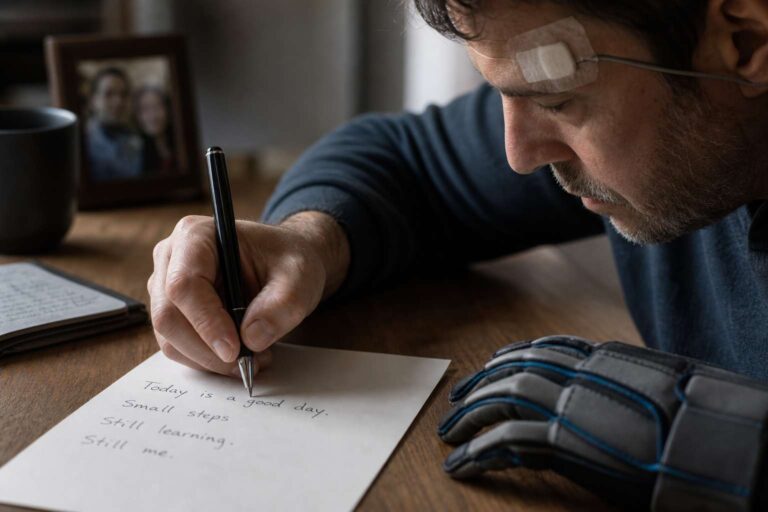
Dong Hui, who was paralyzed from the neck down after a car accident, regained enough hand function to write his name, “Thank you,” and the date after rehabilitation supported by a brain implant. Dong, 39, had sustained spinal cord injuries in a car accident six years earlier that left him paralyzed from the neck down. This was the result of an 11-month-long rehabilitation enabled by an implant in his brain. In November 2024, Dong became one of the first people in China to be given an invasive brain-computer interface through brain surgery, and he joined a clinical trial after seeing television coverage of another paralyzed man using similar technology.
The implant is a coin-size device called NEO, developed by Neuracle Technology in Shanghai together with researchers at Tsinghua University in Beijing. During a procedure that took just over an hour and a half, the device’s sensors were placed on the dura mater, while another implant on the skull transmitted signals to a computer. The computer translated those signals into commands for a soft robotic glove used in daily training. Dong started his rehabilitation around a week after surgery. “On the ninth day of my training, my right hand successfully grabbed a ball without the glove,” he says. NEO is now available to some patients with paralysis in their limbs due to spinal cord injuries, and according to China’s National Medical Products Administration, the product is suitable for patients between 18 and 60 who have paralysis in all limbs due to spinal cord injuries but still have some residual function in their arms.
NEO became the first invasive brain-computer interface product in the world to be approved for use beyond clinical trials this March. Since October 2023, Neuracle has conducted 36 clinical trials using NEO. Thirty-two of them took place in the space of a few months in 2025. Researchers and policy observers cited several reasons for the speed of approval, including the device’s relatively less invasive design compared with systems that penetrate the cortex, and China’s expedited regulatory support for brain-computer interface development.
The decision is seen as a major milestone for the global brain-computer interface sector because it moves the technology from long-running lab work toward large-scale manufacturing and clinical use in China. Days after NEO was approved, China started incorporating it into the country’s health insurance system by assigning it a unique code. Government backing is expected to accelerate the sector further, with brain-computer interface technology named as one of six key industries in China’s latest five-year plan. More domestic products are also advancing, including Beinao-1, which could get the green light as early as 2028.