Physical artificial intelligence models for robots, autonomous vehicles and other machines require safe, generalized training data grounded in the real world, but collecting diverse real-world scenarios can be difficult and dangerous. NVIDIA positions physically based synthetic data generation as a practical solution and has released updates to its Cosmos open world foundation models to accelerate synthetic data creation. By combining Omniverse libraries and Cosmos, developers can generate photorealistic, physically accurate synthetic videos and scenes at scale to reduce the simulation-to-real gap.
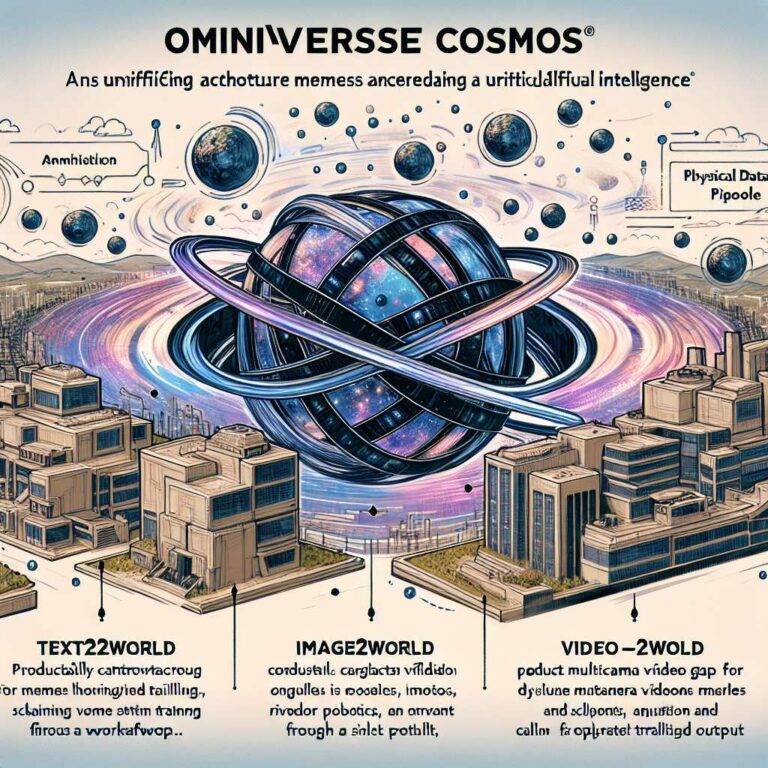
Cosmos Predict 2.5 unifies three prior models – Text2World, Image2World and Video2World – into a single lightweight architecture that produces consistent, controllable multicamera video worlds from a single image, video or text prompt. Cosmos Transfer 2.5 enables high-fidelity, spatially controlled world-to-world style transfer so developers can add new weather, lighting and terrain conditions across multiple cameras. The release notes that Cosmos Transfer 2.5 is 3.5x smaller than its predecessor, delivering faster performance along with improved prompt alignment and physics accuracy. These world foundation models can be integrated into synthetic data pipelines running in NVIDIA Isaac Sim, built on the NVIDIA Omniverse platform.
NVIDIA outlines a four-part synthetic data pipeline that starts with Omniverse NuRec neural reconstruction libraries to create a digital twin in OpenUSD from simple captures such as a smartphone, adds SimReady assets to populate scenes with physically accurate 3D models, uses the MobilityGen workflow in Isaac Sim to generate synthetic data, and leverages NVIDIA Cosmos to augment that data. Multiple companies are already using the pipeline: Skild AI combines Cosmos Transfer with Isaac Lab to train general-purpose robot brains across embodiments; Serve Robotics trains with thousands of simulated scenarios plus real data and reports one of the largest public autonomous robot fleets, more than 100,000 last-mile deliveries and collection of about 1 million miles of data monthly, including nearly 170 billion image-lidar samples.
Other adopters include Lightwheel, which builds simulation-first robotics solutions, FS Studio, which generated photorealistic package variations to improve detection accuracy, Robots for Humanity, which created full simulation environments for oil and gas clients, and community projects such as Scott Dempsey’s cable synthesizer. NVIDIA also points developers to resources including the Getting Started with Isaac Sim learning path, a generative artificial intelligence reference workflow, the NVIDIA Cosmos Cookbook, technical blogs on scene reconstruction and a YouTube playlist, plus NVIDIA Brev for ready GPU environments to support physical artificial intelligence development.