
NVIDIA moves to in-house server production for Artificial Intelligence

NVIDIA will ship finished L10 compute trays as part of its 'Vera Rubin' VR200 stack, shifting core server assembly in-house and constraining OEM hardware differentiation for Artificial Intelligence systems. Volume production is slated for late 2026.

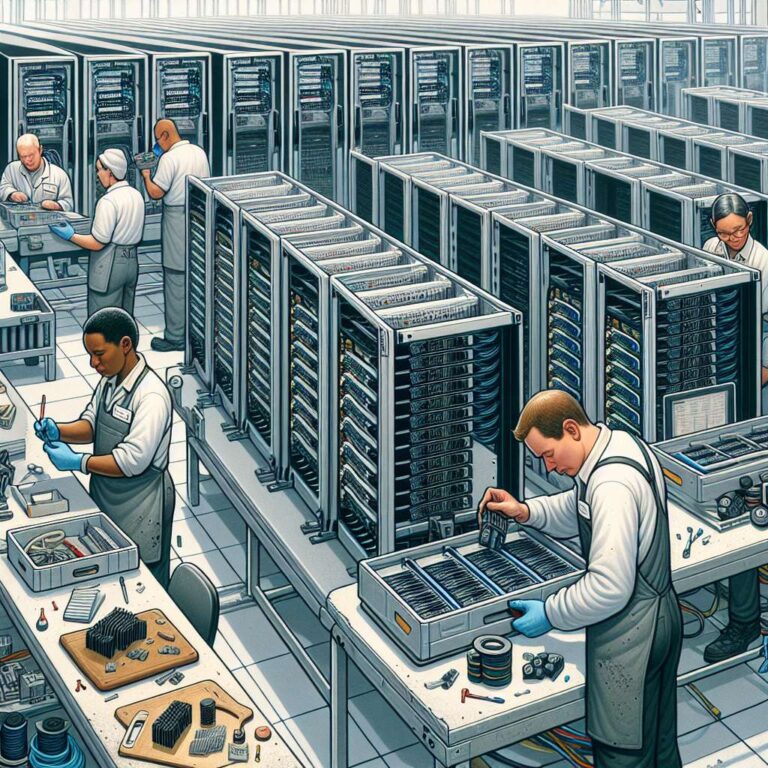
NVIDIA plans to change how high-performance Artificial Intelligence servers are built by shipping fully finished L10 compute trays as part of its ‘Vera Rubin’ VR200 product stack. The company will move beyond supplying CPUs and accelerators to original equipment manufacturers and instead deliver trays pre-populated with ‘Vera’ CPUs, ‘Rubin’ accelerators, memory, 800G network interface cards, 110kW power delivery and liquid-cooling infrastructure. NVIDIA intends for these trays to be validated before they leave the factory, with the VR200 line entering volume production in late 2026.

Reports indicate that the ‘Rubin’ accelerators could have a thermal design power of up to 2.3 kW for the highest-end models, producing rack-level power requirements that exceed 250 kW. That level of heat and power density is cited as a factor making bespoke cooling designs economically unviable. NVIDIA is said to be standardizing cooling and power across two performance tiers and increasing network input and output density, decisions that reduce the feasibility and cost-effectiveness of third-party replication. By centralizing production with select partners, the company aims to shorten development cycles and improve manufacturing yields.

The shift will change the role of system vendors and OEMs. Rather than designing core server electronics, many will focus on rack-level assembly, power configuration, installation of rack cooling sidecars and final certification. The centralized approach limits some of the hardware differentiation options that OEMs and hyperscalers have traditionally used. Overall, the move redistributes responsibilities across the supply chain while emphasizing validated, turnkey compute trays for Artificial Intelligence deployments.
68

Impact Score

Tech firms commit billions to Artificial Intelligence infrastructure

Amazon, OpenAI, Nvidia, Meta, Google and others are signing increasingly large cloud, chip and data center agreements as demand for Artificial Intelligence infrastructure accelerates. The latest wave of deals spans investments, compute purchases, chip supply agreements and data center buildouts.

JEDEC outlines LPDDR6 expansion for data centers

JEDEC has previewed planned updates to LPDDR6 aimed at pushing the memory standard beyond mobile devices and into selected data center and accelerated computing use cases. The roadmap includes higher-capacity packaging options, flexible metadata support, 512 GB densities, and a new SOCAMM2 module standard.

Tsmc debuts A13 process technology

Tsmc has introduced its A13 process at its 2026 North America Technology Symposium as a tighter version of A14 aimed at next-generation Artificial Intelligence, high performance computing, and mobile designs. The company positions the node as a more compact and efficient option with backward-compatible design rules for faster migration.

Google unveils eighth-generation tensor processor units

Google introduced its eighth generation of custom tensor processor units with separate designs for training and inference. The new TPU 8t and TPU 8i are aimed at large-scale model training, serving, and agentic workloads.

Contact Us

Got questions? Use the form to contact us.

Contact Form

Clicking next sends a verification code to your email. After verifying, you can enter your message.