
Large language models require a new form of oversight: capability-based monitoring

The paper proposes capability-based monitoring for large language models in healthcare, organizing oversight around shared capabilities such as summarization, reasoning, translation, and safety guardrails. The authors argue this approach is more scalable than task-based monitoring inherited from traditional machine learning and can reveal systemic weaknesses and emergent behaviors across tasks.

Katherine Kellogg and coauthors from the massachusetts institute of technology, harvard, and northeastern present an 18-page paper proposing capability-based monitoring for large language models used in healthcare. Posted 14 November 2025 and written 5 November 2025, the paper critiques existing monitoring approaches that are task-based and inherited from traditional machine learning. The authors note that task-based monitoring assumes performance degradation driven by dataset drift, an assumption that does not reliably hold for generalist large language models that were not trained for specific tasks or populations.

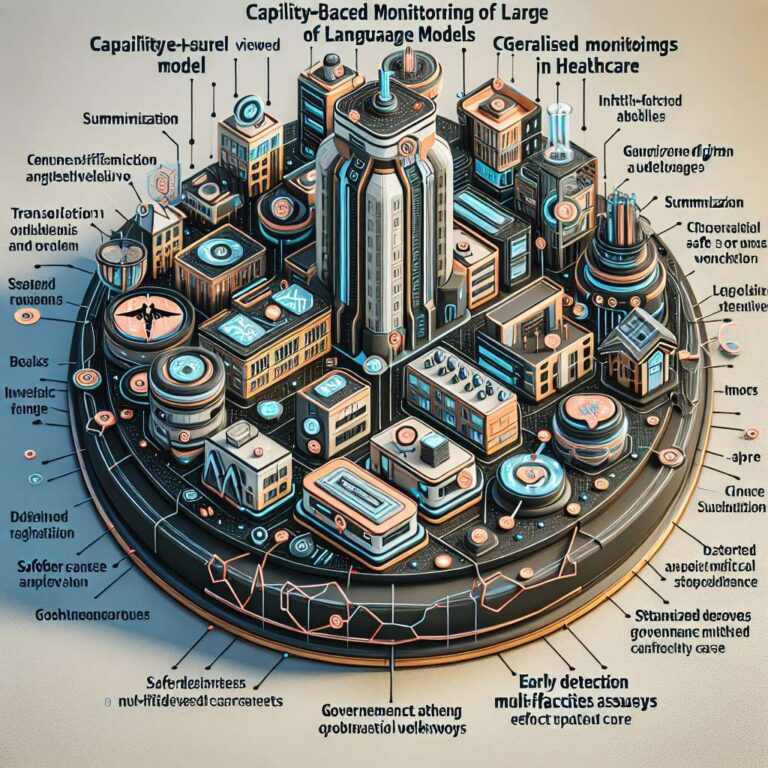
Capability-based monitoring reframes oversight around overlapping internal capabilities that models reuse across many downstream tasks. The paper highlights examples of such capabilities, including summarization, reasoning, translation, and safety guardrails, and argues that organizing monitoring around these shared abilities enables cross-task detection of systemic weaknesses, long-tail errors, and emergent behaviors that task-based approaches may miss. By focusing on capabilities, organizations can detect issues that propagate across multiple applications rather than evaluating each downstream task independently.

The authors describe considerations for implementation aimed at developers, organizational leaders, and professional societies. They propose that capability-based monitoring offers a scalable foundation for safe, adaptive, and collaborative oversight of large language models and future generalist Artificial Intelligence models in healthcare. The paper positions this approach as a practical organizing principle grounded in how these models are developed and used in practice, and as a way to enable broader detection and mitigation of failures that affect multiple clinical and operational use cases.
55

Impact Score

Tech firms commit billions to Artificial Intelligence infrastructure

Amazon, OpenAI, Nvidia, Meta, Google and others are signing increasingly large cloud, chip and data center agreements as demand for Artificial Intelligence infrastructure accelerates. The latest wave of deals spans investments, compute purchases, chip supply agreements and data center buildouts.

JEDEC outlines LPDDR6 expansion for data centers

JEDEC has previewed planned updates to LPDDR6 aimed at pushing the memory standard beyond mobile devices and into selected data center and accelerated computing use cases. The roadmap includes higher-capacity packaging options, flexible metadata support, 512 GB densities, and a new SOCAMM2 module standard.

Tsmc debuts A13 process technology

Tsmc has introduced its A13 process at its 2026 North America Technology Symposium as a tighter version of A14 aimed at next-generation Artificial Intelligence, high performance computing, and mobile designs. The company positions the node as a more compact and efficient option with backward-compatible design rules for faster migration.

Google unveils eighth-generation tensor processor units

Google introduced its eighth generation of custom tensor processor units with separate designs for training and inference. The new TPU 8t and TPU 8i are aimed at large-scale model training, serving, and agentic workloads.

Contact Us

Got questions? Use the form to contact us.

Contact Form

Clicking next sends a verification code to your email. After verifying, you can enter your message.