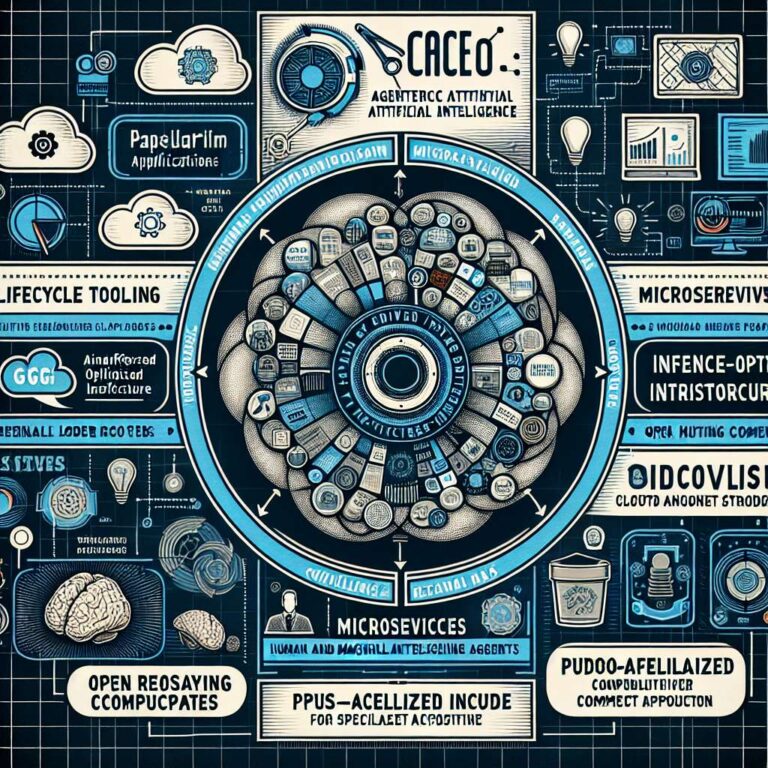
Nvidia presents a comprehensive guide to building agentic artificial intelligence, describing systems that use sophisticated reasoning and planning to solve complex, multi‑step problems. These agentic artificial intelligence systems ingest data from multiple sources, analyze challenges, devise strategies, and complete tasks independently, transforming enterprise data into actionable knowledge. Over time, agents improve via a data flywheel that incorporates human and artificial intelligence feedback to refine models and outcomes.
The company positions three core building blocks: Nvidia NeMo to build, monitor, and optimize agents across their lifecycle; Nvidia NIM microservices to speed deployment of performance‑optimized generative artificial intelligence models through stable, secure APIs with enterprise support; and Nvidia Blueprints to accelerate development with customizable reference workflows. GPU‑accelerated cloud instances are available for quick starts. Nvidia also highlights industry momentum, noting open reasoning models in Nemotron and Cosmos that can think up to 9x faster to lower inference costs across customer service, cybersecurity, manufacturing, logistics, and robotics, and that OpenAI gpt‑oss is available as Nvidia NIM for deployment on GPU‑accelerated infrastructure with data privacy and enterprise‑grade security.
For models and inference, the page emphasizes optimized performance for the latest reasoning and generative artificial intelligence models. NIM ships with accelerated inference engines from Nvidia and the community, including Nvidia TensorRT and TensorRT‑LLM, prebuilt for low‑latency, high‑throughput inferencing on Nvidia‑accelerated infrastructure. Nvidia also defines an artificial intelligence factory as specialized compute that streamlines the whole lifecycle from data ingestion to high‑volume inference. The Nvidia Enterprise Artificial Intelligence Factory is presented as a full‑stack validated design for building and deploying high‑performance, scalable, and secure on‑premises platforms.
Resources include video demos such as building a simple agent in minutes, a reasoning on or off scenario, and workplace applications. Use cases span a digital human for customer service, a video analysis agent that ingests live or archived video for summarization and interactive Q&A, and a PDF‑to‑podcast blueprint for creating audio content. Nvidia invites developers to explore models, code, and partner microservices via Blueprints, and to tap an ecosystem of models, toolkits, vector databases, frameworks, and infrastructure. The page closes with next steps to get started, contact sales for Nvidia Artificial Intelligence Enterprise, subscribe for updates, and a spotlight on Nvidia NeMo as a comprehensive suite for agent lifecycle management at enterprise scale.