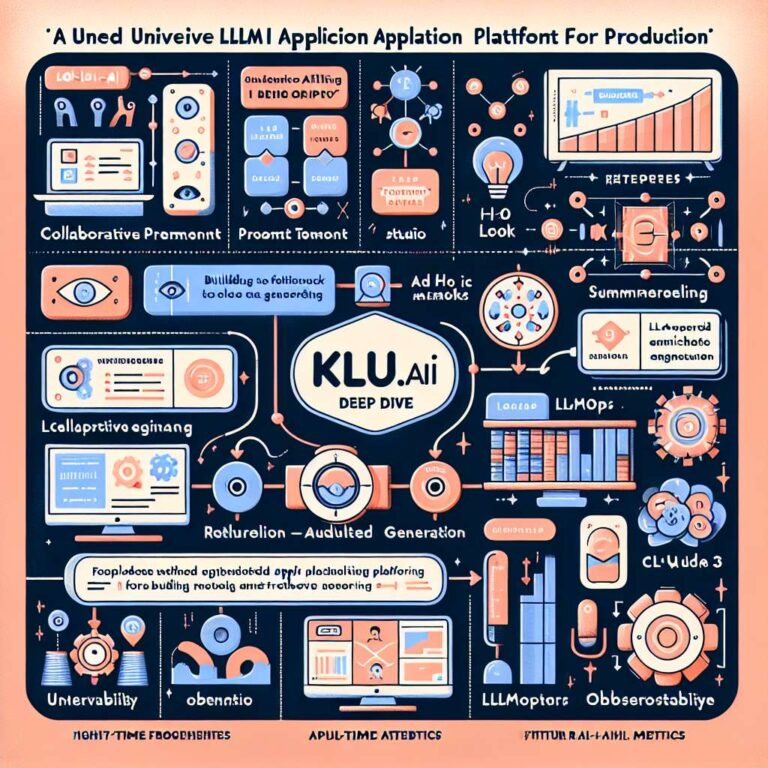
The article examines Klu.ai as an LLM application platform designed to consolidate a fragmented Artificial Intelligence stack into a single workflow spanning design, deployment, and operations. It contrasts the traditional mix of frameworks, vector databases, and ad hoc logging with Klu.ai’s integrated approach, targeting Artificial Intelligence engineers, product managers, and startups. It also distinguishes between Klu.ai, the developer platform under review, and Klu.so, an end-user meeting assistant built with similar capabilities.
Key components include the Klu Studio for collaborative prompt engineering and versioning, a unified API to access models from providers such as OpenAI, Anthropic, Google, and Together AI using a team’s own keys, and “Context,” a managed retrieval-augmented generation system that handles embeddings, chunking, and indexing across sources like Slack, Google Drive, Salesforce, Notion, GitHub, databases, and common file types. The platform embeds LLMOps by default, automatically logging calls, monitoring latency, cost, token usage, and capturing user feedback, enabling a Build → Deploy → Measure → Learn → Iterate loop. The review argues this integrated observability differentiates Klu.ai from open-source frameworks where monitoring often requires separate tools.
In comparisons, Klu.ai is framed as a managed, opinionated platform that prioritizes speed, reliability, and built-in analytics, while LangChain is praised for flexibility but noted for added operational burden when moving to production. Retool is presented as complementary for UI, with Klu.ai powering the LLM logic behind the scenes. A step-by-step example builds a “Customer Feedback Summarizer” by uploading reviews to Context, creating an Action in Studio, iterating prompts to improve specificity, A/B testing models like GPT-4o and Claude 3 Sonnet, deploying via the SDK using an Action ID, and observing real-time analytics in production.
Looking ahead, the article highlights trends toward agentic workflows using Actions and Workflows, the pursuit of an “AI moat” through continuous data collection and fine-tuning, and a shift from LLMOps to “product Artificial Intelligence ops” that ties model performance to product and business metrics. Pricing is described as tiered, from a free trial with prototyping runs through Pro and Scale to Enterprise, which adds security, SSO, activity logs, and options like the Klu Enterprise Container. The platform supports connecting fine-tuned models via provider keys and self-hosted models at the enterprise level.
The review’s verdict is positive: Klu.ai accelerates development, improves cross-team collaboration, and reduces cognitive load by integrating prompting, RAG, and analytics. Trade-offs include a learning curve around platform concepts, potential cost considerations at scale, and an opinionated architecture that may not fit highly bespoke research use cases.