
Intel debuts Xeon 600 series Granite Rapids-WS workstation CPUs

Intel has introduced the Xeon 600 series Granite Rapids-WS workstation processors, aiming at high core count, single-socket systems with expanded memory and I/O to challenge AMD's Ryzen Threadripper Pro 9000 series.

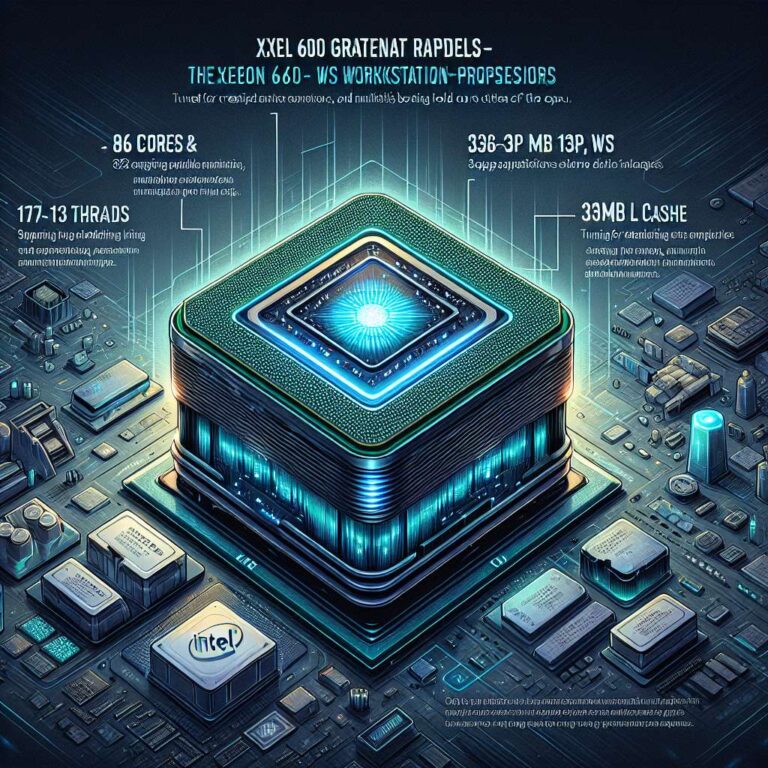
Intel has launched the Xeon 600 series workstation processors, codenamed Granite Rapids-WS, targeting single-socket workstations that prioritize high core counts, large memory capacity and extensive I/O for multi-GPU and storage-heavy builds. The lineup is positioned as the successor to the Sapphire Rapids based Xeon W-2500 and W-3500 series and is designed to compete directly with AMD’s high-end workstation offering, the Ryzen Threadripper Pro 9000 series. Intel has 11 SKUs in the Xeon 600 series, and all of them are built around Redwood Cove performance cores only, with no efficiency cores included.

At the top of the range, the Xeon 698X features 86 cores and 172 threads, backed by 336 MB of L3 cache. The chip runs at a 2.0 GHz base clock, boosting up to 4.8 GHz with Turbo Boost Max 3.0, or 4.6 GHz under Turbo Boost 2.0. Intel confirms that the 698X is fully unlocked, allowing overclocking, which remains relatively uncommon in the Xeon workstation segment. The platform is aimed at creators, engineers and technical professionals who need extreme parallel performance and configurability in a single-socket tower or rack workstation.

The processors pair with the Intel W890 chipset, which offers up to 128 PCIe 5.0 lanes directly from the CPU. The platform features eight memory channels supporting DDR5-6400 RDIMMs, and up to 4 TB of system memory. Compared to the previous Xeon WS generation, Granite Rapids-WS introduces larger L2 and L3 caches, CXL 2.0 support and refreshed platform capabilities for expansion and connectivity. Intel also incorporates vPro Enterprise, along with Intel Deep Learning Boost technologies including VNNI, AVX-512 and AMX, to target Artificial Intelligence inference and other advanced compute workloads that benefit from accelerators and high bandwidth memory and I/O.
56

Impact Score

EU Artificial Intelligence Act amendments delay some deadlines and add new bans

A provisional Digital Omnibus on Artificial Intelligence would push back several EU Artificial Intelligence Act deadlines, refine how the law interacts with sector rules, and introduce new prohibited practices. The package also expands limited bias-testing allowances and strengthens centralized oversight for some high-impact systems.

Qwen 3.5 raises concerns about censorship embedded in model weights

A technical analysis of Alibaba Cloud’s Qwen 3.5 points to political censorship circuits embedded directly in the model’s learned weights. The findings highlight operational, compliance, and product risks for startups building on third-party Artificial Intelligence models.

Laptop prices rise as memory shortages hit PCs

Laptop prices are climbing as memory makers redirect production toward data center demand driven by Artificial Intelligence. The squeeze is spreading beyond RAM to graphics memory and SSDs, raising costs across the PC market.

Artificial Intelligence models split on job disruption estimates

A new working paper finds that leading Artificial Intelligence models give sharply different answers when asked which jobs they are most likely to disrupt. The findings raise doubts about using model-generated exposure scores to guide labor policy or economic analysis.

Contact Us

Got questions? Use the form to contact us.

Contact Form

Clicking next sends a verification code to your email. After verifying, you can enter your message.