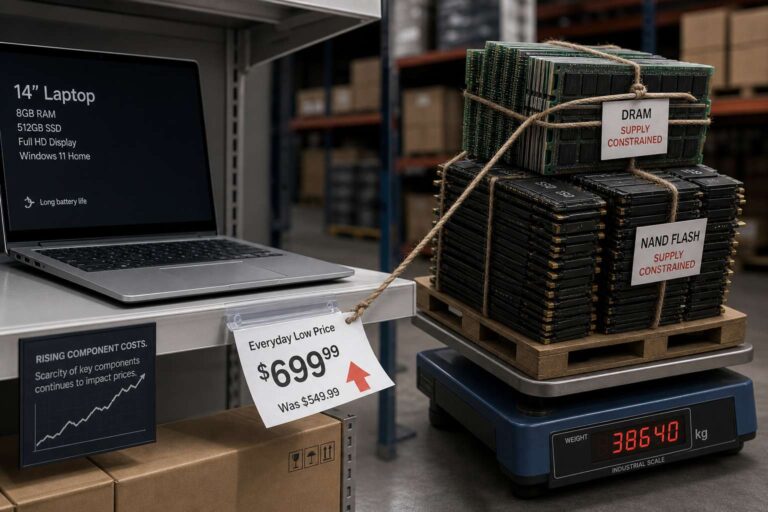
Laptop prices have surged in 2026 as memory and storage costs jump sharply, pushing up the cost of complete PCs and key components. The main driver is demand from Artificial Intelligence infrastructure, where massive memory capacity is critical for data centers and model performance. That demand is absorbing a large share of manufacturing capacity at major memory suppliers including Micron, Samsung, and SK Hynix, leaving less supply available for consumer devices and keeping pressure on laptop pricing.
This year, Artificial Intelligence-centric memory is projected to consume 70% of global memory hardware production, according to TrendForce. To meet that demand, chipmakers are shifting output toward high-bandwidth memory and server-grade DDR5, reducing supply for consumer systems. Micron has exited the direct-to-consumer memory market entirely, shutting down its Crucial sub-brand, while continuing to supply commercial PC makers. With supply constrained and demand still strong, manufacturers and large buyers are locking in future wafer and chip production, reinforcing expectations that elevated prices will persist for a year or more and potentially much longer.
The shortage is not limited to standard laptop RAM. Prices are also rising for DDR4 and DDR3, while graphics cards face the same pressure because they rely on dedicated video memory. The cost per gigabit for GDDR6 and GDDR7 has more than tripled in the last six months, and that increase is expected to feed directly into more expensive desktop and laptop graphics hardware. SSD pricing is also under strain because DRAM and NAND production overlap, and NAND wafers have already surged, jumping as much as 60% month-over-month last November, according to Procurement Pro.
Major laptop brands including Dell, HP, and Lenovo have already publicly estimated price hikes of 15% to 30%, and smaller companies such as Framework have raised RAM prices and prioritized full-system sales over standalone parts. Existing inventory has softened the impact for some vendors, including Apple, but that buffer is expected to fade as lower-cost stock runs out. The outlook points to broad price increases across categories, from Chromebooks to gaming laptops, with high-memory systems becoming especially expensive. A ? laptop quickly becomes a ? laptop when you factor in a 30% price increase, while machines under ? may become harder to find.
The shift is also likely to change laptop configurations. Moderately priced systems may top out at 16GB more often, while 32GB and 64GB models move further into premium territory. More ultraportables may use soldered memory, limiting upgrade options. For buyers, the practical advice is to purchase sooner if a new laptop is already planned, consider paying upfront for more memory if future needs are likely, and look at 2025 or 2024 models that were priced before the current memory crunch took hold.