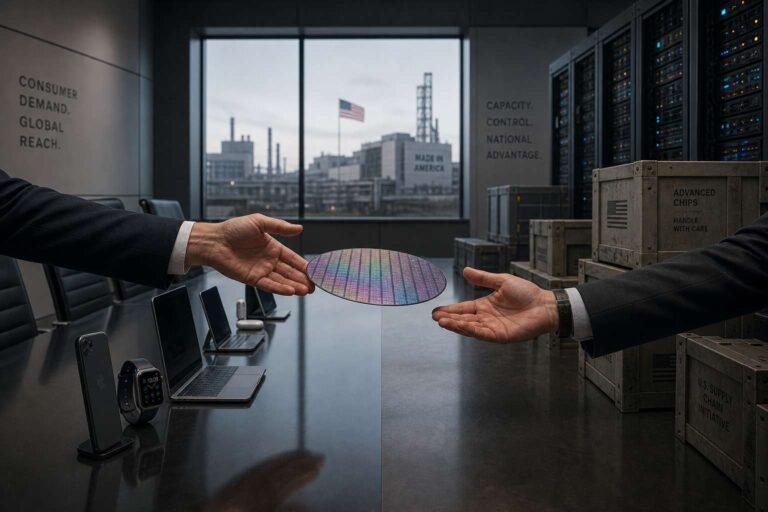
Intel has reportedly signed a preliminary deal with Apple to make some chips for its devices, underscoring how the semiconductor industry is being reshaped by commercial pressure and geopolitical strategy. The agreement would give Intel a high-profile endorsement for its foundry business, a central part of its turnaround effort, while helping Apple diversify manufacturing at a time when its supply chain has been strained by demand from Artificial Intelligence chipmakers such as Nvidia. Reports also indicate the US government played a significant role, highlighting how closely state policy is now tied to chip production.
The deal could help Intel restore credibility in advanced manufacturing after years of lagging Taiwan Semiconductor Manufacturing Company. Under its “IDM (Integrated Device Manufacturing) 2.0″ strategy, Intel expanded fabrication plans and launched Intel Foundry Services to compete with TSMC, but the effort has been hindered by delays, yield issues and financial losses. Apple is known as one of the industry’s most demanding chip customers, so winning its business could validate Intel’s manufacturing capabilities and attract more clients. Investors have been warming up to Intel in recent months, with its stock price doubling since April. The reports of the Apple deal on 8 May led to a further rise.
The partnership also marks another turn in the long relationship between the two companies. Apple moved from PowerPC chips to Intel processors in 2005, then shifted away again as it developed its own ARM-based chip designs and relied on TSMC for production. By 2020, Apple had designed its own processors for Macs and relied on TSMC to manufacture them. Apple has announced that the upcoming macOS release expected in September will drop support for Intel-based Macs. Intel’s revenues have been shrinking since 2021 as the company missed on Artificial Intelligence-boom opportunities. The current deal marks a fresh beginning for Intel. While it will not be supplying its own chips for Apple devices, it will manufacture Apple-designed chips.
Apple’s motivation is rooted in manufacturing constraints. It remains heavily dependent on TSMC for nearly all of its custom chip output, but that position has weakened as Nvidia and AMD consume more advanced capacity. Artificial Intelligence chips take up more wafer space and carry higher margins than consumer electronics chips, reducing Apple’s historical leverage. In his January analyst call, Apple CEO Tim Cook said shortage of advanced chips had affected the company’s ability to fully meet demand for some products. He said Apple is “in supply chase mode to meet the very high levels of customer demand” and is “currently constrained” by advanced node availability.
The pressure from Artificial Intelligence infrastructure spending is intensifying. Hyperscaler-driven Artificial Intelligence infrastructure spending has surged since 2023, with combined capital expenditure reaching hundreds of billions in 2025 and projected to climb further in 2026. Nvidia dominates the Artificial Intelligence accelerator market with over 80% share, its data center growth enabling it to overtake Apple as TSMC’s largest customer in 2025. At TSMC, Apple’s revenue share declined to around 17%, while Nvidia’s rose to 19% for 2025. The foundry’s HPC and Artificial Intelligence segment now accounts for over 55% of revenue. Advanced nodes and CoWoS packaging remain constrained, with demand expected to exceed supply by 25-30% through 2026-2027 despite massive capex. Capex on chips and servers is projected to cross ? billion by 2028, from an estimated ? billion in 2025, per Morgan Stanley Research.
Geopolitics adds another layer to the shift. Reducing reliance on TSMC also helps Apple manage Taiwan-related risks amid tensions between the US and China. According to reports, federal officials encouraged the tie-up, leveraging influence they gained after the US traded nearly ? billion in grants for a 10% stake in Intel last year. The broader aim is to bring more advanced chip production back to the US, with Intel positioned as the only major US-headquartered company trying to compete with Asian foundries at the leading edge. Analysts estimate Intel’s production costs remain significantly above TSMC’s, partly because Intel’s manufacturing yields are lower, leaving open the question of whether renewed momentum can turn into a lasting comeback.