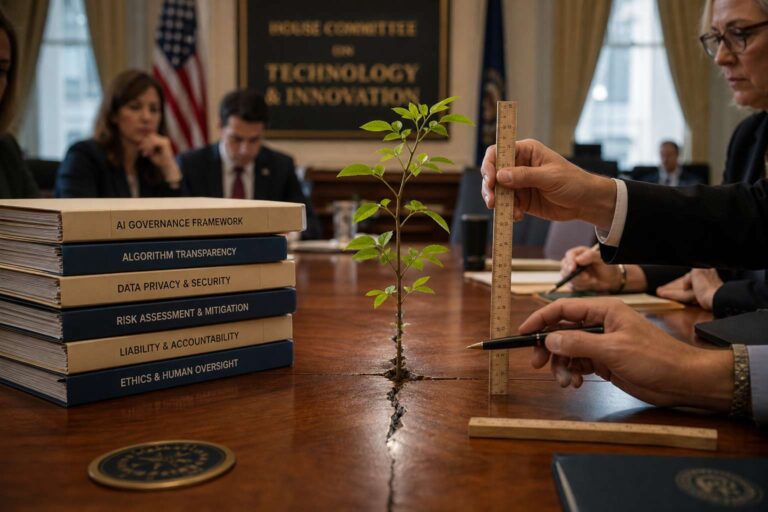
Illinois lawmakers are moving toward a more active role in regulating Artificial Intelligence as the technology spreads across business, government, and consumer services. Committees in both chambers of the Illinois General Assembly have reviewed proposals that would restrict certain uses of Artificial Intelligence and shape how it is deployed in state government and specific industries. On April 9 and 10, the Senate held two virtual subject matter hearings on nearly 50 bills about Artificial Intelligence and consumer protection, privacy, education and data centers. Lawmakers framed the debate around avoiding past mistakes made with social media while trying to put guardrails in place before harms become more entrenched.
The main points of tension are liability, consumer safety, and how far Illinois should go without discouraging innovation. Senators said they do not want to drive away business development, but they remain especially concerned about chatbots and minors. Some lawmakers argued that companies should not be shielded from responsibility when automated systems give harmful or incorrect information. Existing Illinois laws already touch Artificial Intelligence in areas such as image manipulation, intellectual property, and biometric privacy, and legal scholars noted that tort law is already being used in early chatbot cases. Even so, legislators signaled that current law may not be enough to address the risks posed by increasingly capable systems.
Workplace use is another major front in the debate. The Illinois Chamber of Commerce is working with the Illinois Department of Human Rights on implementation of a bill passed in 2024 that prohibits employers from using Artificial Intelligence for recruitment, hiring and other employment-related decisions in ways that could result in discrimination of a protected class like gender or race. Business representatives said compliance remains difficult because rules have not yet been adopted, despite a Jan. 1 effective date. Human resource advocates said employers are increasingly using Artificial Intelligence in daily operations, but stressed that human oversight remains essential and that workers will need more specialized technical skills.
Industry groups are also urging Illinois to avoid becoming a regulatory outlier. They argued that a state-by-state patchwork would complicate compliance for companies operating across multiple jurisdictions and said Illinois should align with other states where possible. That position overlaps with the president’s executive order favoring innovation over broad regulation and criticizing state laws that could impede national policy. At the same time, lawmakers are continuing negotiations with industry stakeholders as outside donors spend heavily on “pro-AI” candidates. Illinois is one of 19 states in the country who has started to try to regulate, to some extent, the use of Artificial Intelligence. The broader path forward remains uncertain as state officials weigh consumer protections against economic interests and await any federal challenge.