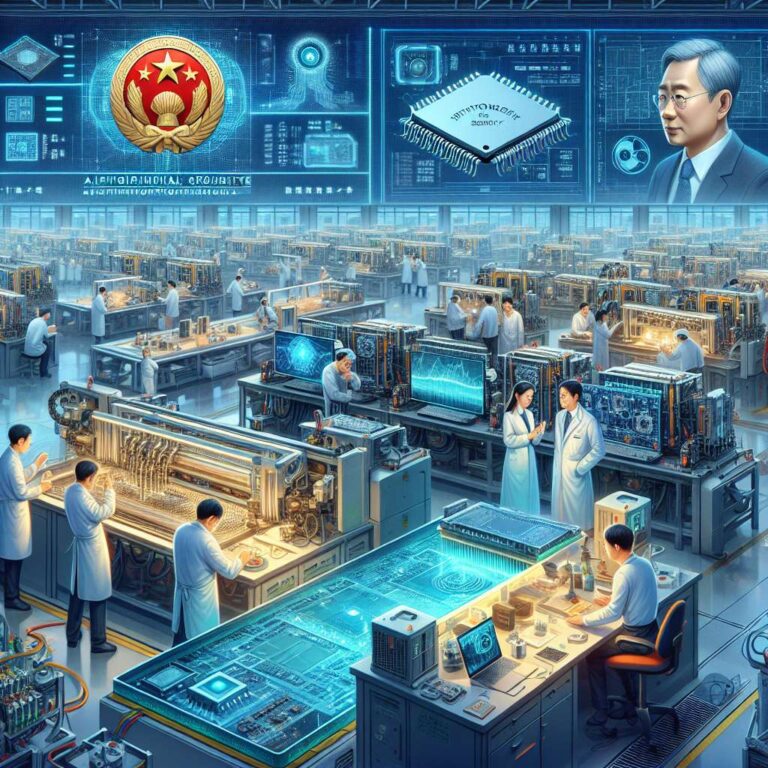
China has quietly assembled a sprawling, state-backed campaign to challenge western dominance in advanced semiconductors and Artificial Intelligence computing, with officials and executives describing it as a strategic project on the scale of a wartime mobilization. The initiative is framed as a response to tightening United States export controls that are cutting China off from cutting edge chips designed by companies like Nvidia and AMD and produced by chipmakers such as TSMC, Intel, and Samsung. Chinese planners have treated access to high performance chips as a national security priority, knitting together ministries, state-owned enterprises, private firms, and universities into a coordinated push.
According to people involved, Beijing has directed large pools of state funding into a cluster of programs aimed at reproducing or replacing critical parts of the global chip supply chain. Officials have pressed domestic firms to design and manufacture accelerators and other processors that can support Artificial Intelligence training and inference workloads on par with western offerings. State entities have also encouraged national champions to secure or clone chipmaking equipment, including lithography tools that underpin extreme ultraviolet and deep ultraviolet manufacturing. ASML built its first working prototype of EUV equipment years before China began its current wave of investment, underscoring the technological lead Chinese engineers are trying to close.
The effort spans everything from chip design software and memory to packaging and cloud infrastructure, with local governments offering subsidies, tax breaks, and land to attract fabrication plants and research centers. Engineers describe an environment where meeting political and strategic targets is as important as commercial performance, and where success is defined by reducing vulnerability to foreign pressure rather than simply winning market share. While the campaign has produced some progress in chip design, manufacturing, and Artificial Intelligence computing clusters, insiders acknowledge that China still lags in the most advanced tools and processes and faces obstacles including talent shortages, fragmented projects, and the risk of wasteful duplication across regions and bureaucracies.