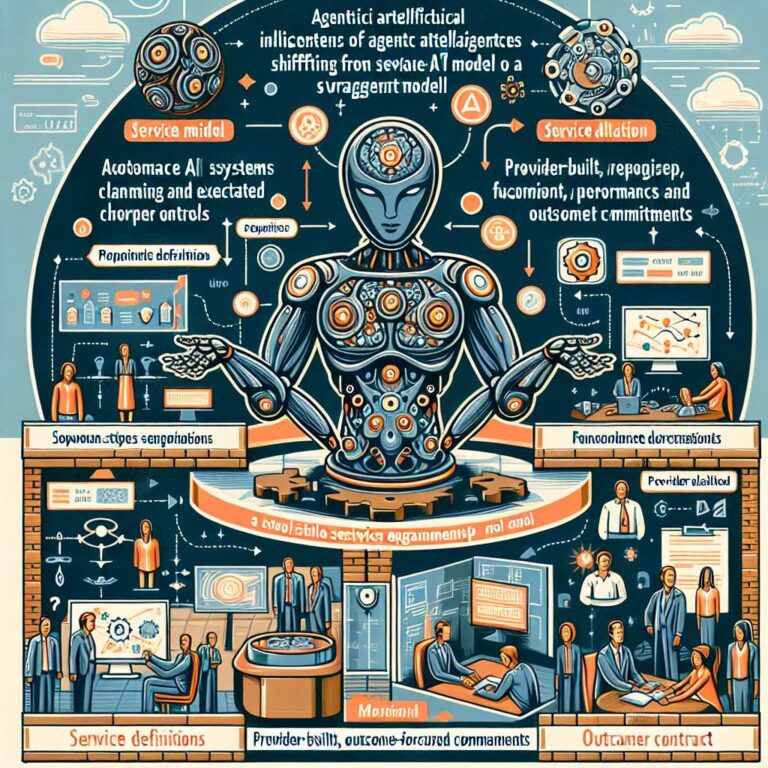
Enterprises deploying agentic artificial intelligence are being urged to rethink traditional Software-as-a-Service contracts in favor of a hybrid model that combines SaaS with business process outsourcing concepts. As agentic artificial intelligence systems move from passive copilots to autonomous actors that plan and execute multi-step tasks on a company’s behalf, the relationship between provider and customer starts to resemble a services engagement rather than a simple software license. That shift raises familiar outsourcing concerns around defining the services, setting guardrails and governance, and allocating responsibility for business outcomes and failures, which standard SaaS terms are not designed to address.
The analysis contrasts two types of agentic artificial intelligence offerings: general-purpose tools used by companies to build their own agents, and provider-built solutions that perform specific functions such as supplier payment inquiries or employee benefits support, where customer control is limited. For the latter, six critical contract areas need to evolve. Service definitions and scope must specify the provider’s “delegation of authority,” including what agents can and cannot do, and codify “policy guardrails” with clear human-in-the-loop escalation thresholds. Service warranties should move beyond “THE SERVICE IS PROVIDED AS-IS, WITH ALL FAULTS.” to BPO-style commitments that services, including work by agents, will be performed in a good, professional, diligent, and workmanlike manner, in accordance with industry standards, applicable law, and the agreed guardrails.
Service level agreements are expected to focus on operational outcomes instead of pure technical availability, since 99.99% “uptime” is a common standard in a SaaS agreement but provides limited comfort if an always-on agent is making costly errors. Example metrics include “Accuracy: e.g., 99% of invoices processed correctly against the purchase order.”, “Timeliness: e.g., 99% of support tickets actioned within the required service window.”, and “Satisfaction: e.g., <1% of autonomous actions lead to consumer complaints.” Indemnification provisions should expand beyond narrow intellectual property coverage to address third-party claims arising from agents’ autonomous performance of services within scope, with carve-outs for customer misconfiguration, bad data, or human-approved escalations. Governance and audit rights need to shift from generic SOC reports to a “right to transparency,” including access to decision logs and performance assessments. Finally, data and intellectual property terms should clearly state that the company owns all inputs and outputs, strictly limit any license to use that data, and explicitly prohibit using company data to train models without consent. The emerging contracting approach blends scalable subscription economics from SaaS with BPO-style performance, risk allocation, and oversight, aiming to support services delivered via agentic artificial intelligence in a balanced way for both buyers and providers.