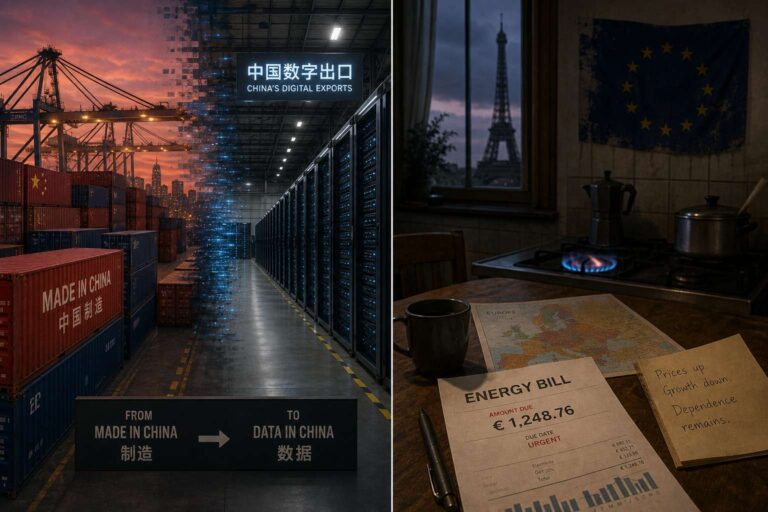
China is emerging rapidly in Artificial Intelligence services, with open-source models reaching token-processing volumes close to US counterparts, according to a Jefferies research report. Data from OpenRouter shows China’s top nine Artificial Intelligence models processed 4.37 trillion tokens in the week ended April 26, compared with 4.98 trillion for US models. This followed a record 12.96 trillion tokens processed by Chinese models in the week ended April 5, outpacing US models’ 3.03 trillion.
The report links that momentum to China’s ability to use cheap energy and computing power to expand exports of digitally delivered knowledge services. China ranked as the world’s sixth-largest exporter of digitally-delivered services in 2025, with exports rising at an annualised 15.2% over 20 years to ? billion, up from ?.4 billion in 2005. While still below India’s ? billion, the trend points to a broader Chinese export profile that extends beyond manufactured goods.
In Europe, political and economic tensions tied to the US-Iran conflict are becoming more visible. German Chancellor Friedrich Merz criticised Washington’s strategy, saying “the Iranians are clearly stronger than expected” and that “the Americans clearly have no truly convincing strategy.” The remarks signal a notable shift from Berlin’s more cautious approach after the Ukraine war, when Germany replaced cheap Russian energy with US LNG.
Economic pressure in Europe is also showing up in consumer data. Germany’s GfK consumer climate index fell 5.2 points to minus 33.3 in May, the lowest since February 2023 and the sharpest monthly decline since October 2022. European leaders are also questioning the role of over 40 US military bases hosting 85,000 troops, while some are considering direct talks with Iran to protect access through the Strait of Hormuz, through which 34% of seaborne crude oil and 19% of LNG passes.
Pressure is also rising inside the US. Polling shows 61% disapprove of military strikes on Iran and 63% disapprove of Trump’s economic handling, increasing calls for a diplomatic exit. The report adds that the UAE’s decision to exit OPEC on May 1 signals wider fractures in the Gulf as the conflict continues.