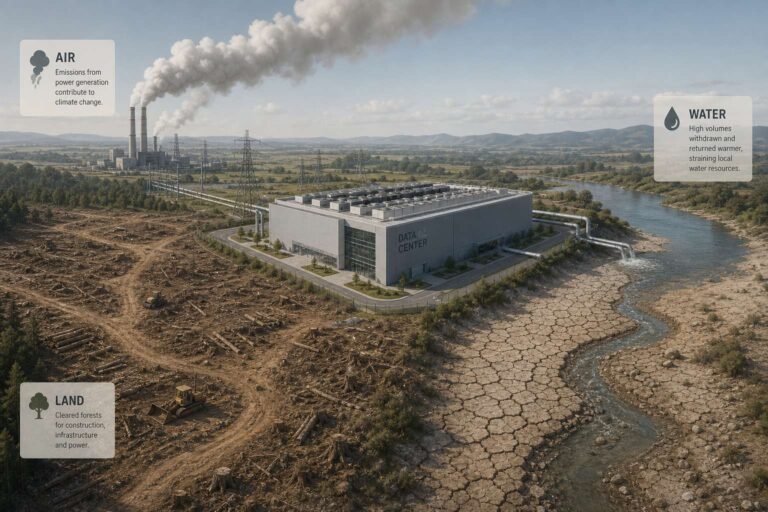
Artificial Intelligence’s rapid growth is increasing demand for the physical systems that make digital services possible, including data centers, advanced chips, cooling systems, electricity grids, water resources, land and critical mineral supply chains. The United Nations University Institute for Water, Environment and Health frames Artificial Intelligence not only as software, but as a material system with measurable environmental costs tied to the energy required to train, deploy and operate models at scale.
The environmental footprint of Artificial Intelligence depends on more than the volume of electricity consumed. Where that electricity is generated and which energy sources power it shape the resulting carbon, water and land impacts. Every kilowatt-hour used by Artificial Intelligence carries implications across these categories, and those impacts do not always align. Low-carbon electricity is not automatically low-water or low-land, making a carbon-only assessment too narrow for understanding the full environmental burden.
Infrastructure trends are intensifying the issue as data centers expand to support wider use of Artificial Intelligence across economies, public services, research, communication and daily life. Everyday usage patterns also matter. Model choice, output length, modality and the growing use of text, image and video generation all influence resource demand. These factors make Artificial Intelligence’s footprint a combined result of large-scale infrastructure decisions and routine user behavior.
The environmental costs also raise governance and justice concerns. Benefits from Artificial Intelligence can flow across borders and sectors, while burdens linked to data center siting, electricity demand, water withdrawals, land use, mineral extraction and e-waste may concentrate in specific communities and regions. A responsible Artificial Intelligence ecosystem would require transparency, efficiency by design, equity and environmental justice, lifecycle responsibility, global cooperation and sustainable use. Making carbon, water and land footprints visible and comparable can help integrate Artificial Intelligence into energy, climate, water and land-use planning without shifting environmental costs onto vulnerable communities.