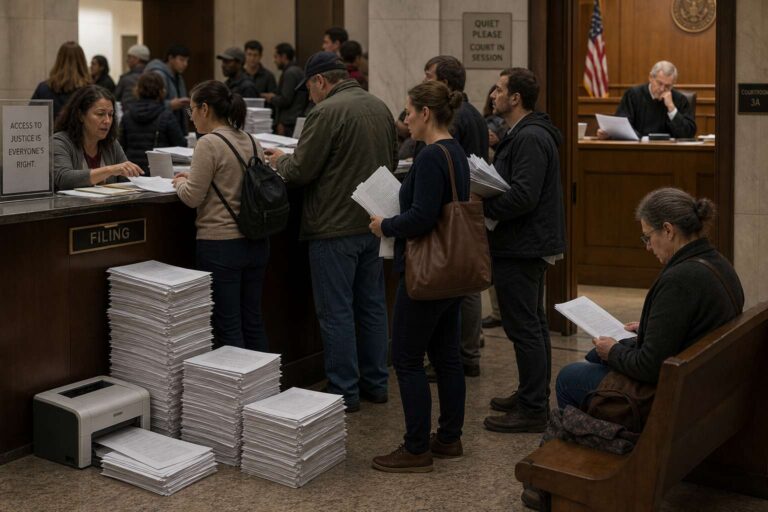
Federal courts are seeing a growing wave of lawsuits and motions from people representing themselves, and judges increasingly link the shift to Artificial Intelligence tools. According to a new study that examined 4.5 million federal civil cases from 2005 to 2026, the share of lawsuits brought by self-represented people increased from 11% in 2022 to 16.8% in 2025. Within those cases, the number of filings made more than doubled from pre-2023 levels. Judges say large language models are helping people without legal training write more coherent pleadings, even as they create new risks through hallucinated cases, fabricated quotes, and flawed legal reasoning.
To test whether Artificial Intelligence was driving the increase in lawsuits filed by people without a lawyer, the authors of the study, Anand Shah at MIT and Joshua Levy at the University of Southern California, ran 1,600 randomly sampled court documents through Pangram, a commercial Artificial Intelligence-text detector. The share flagged as containing Artificial Intelligence-generated writing rose from 1% in 2023 to 18% in 2026. Some judges say the added volume increases workload, but clearer filings can also make cases easier to understand and rule on. In December 2024, a viral Reddit post walked immigration applicants through suing the United States Citizenship and Immigration Services over delayed review of their applications. Cases filed by people without lawyers in Vermont rose from about 45 a year before 2022 to more than 1,100 in 2024. Even so, self-represented litigants remain far more likely to lose than people with lawyers, because litigation involves far more than drafting text.
Courts are also wrestling with whether chatbot conversations used to prepare legal cases should be protected from disclosure. A federal court in Michigan ruled that a self-represented person’s conversations with ChatGPT were shielded work product, while a federal court in New York found that documents generated using Claude were not privileged because Claude is not an attorney and user communications may be disclosed by Artificial Intelligence companies. Judge Maritza Braswell later ruled that chatbot use should remain off limits in one case, leaving courts split on privacy expectations.
The legal system is also beginning to confront liability when chatbots provide bad legal advice. Judges have reported seeing litigants rely on ChatGPT for unrealistic settlement demands, prompting concerns that chatbots may be functioning like unlicensed legal advisers. Nippon Life Insurance Company sued OpenAI, alleging ChatGPT practiced law without a license and helped revive a settled lawsuit with frivolous filings. OpenAI asked the court to dismiss the case, arguing that ChatGPT does not practice law. State and federal lawmakers have proposed measures to stop chatbots from posing as lawyers and other licensed professionals, but those efforts have yet to gain traction.