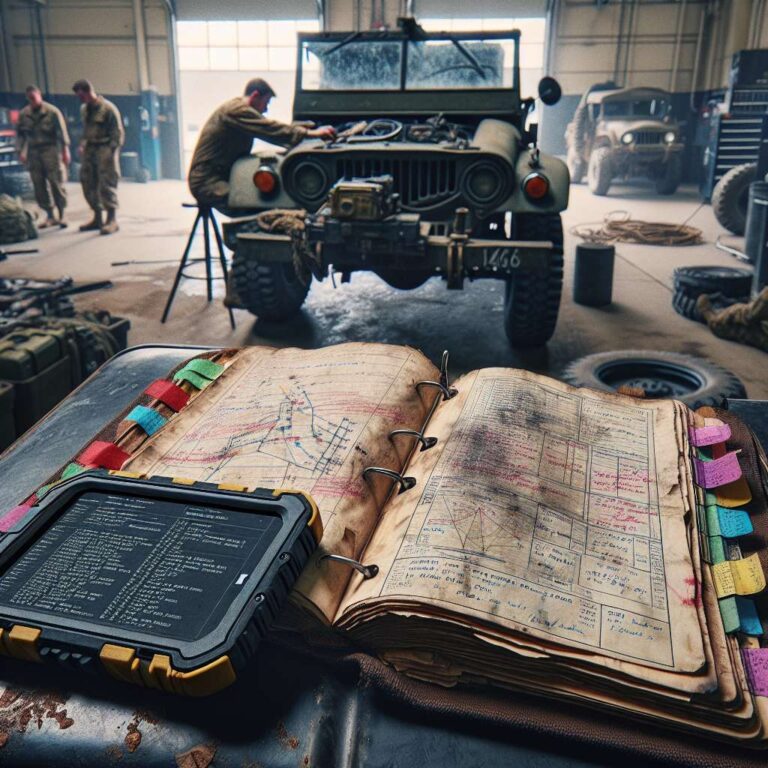
The U.S. Army Communications-Electronics Command Integrated Logistics Support Center headquarters Artificial Intelligence-Assisted Maintenance team, working with the CECOM Software Engineering Center, is developing an Artificial Intelligence-Assisted Maintenance tool as part of a broader Logistics Assistance Program Transformation Initiative. As part of this effort, chief warrant officer Lou Gerber and developer Sean Murphy traveled to the National Training Center in Fort Irwin, California, to demonstrate the tool to soldiers and logistics assistance representatives, show its practical value, and capture feedback grounded in real training scenarios. The demonstration marked a key step in validating how the application could function in the demanding environment of field operations.
Following the initial demonstration, the Artificial Intelligence-Assisted Maintenance development team conducted unit acceptance testing with the 53rd Infantry Brigade Combat Team’s brigade support battalion. During this test, the unit used the tool to support operation, troubleshooting, and maintenance of systems including Advance Medium Mobile Power Sources, Joint Battle Command Platform, and Mounted Mission Command Software. Artificial Intelligence-Assisted Maintenance gives soldiers 24/7 access to expert-level troubleshooting, reducing diagnostic time and accelerating the return of equipment to service, and when the system cannot resolve a problem it automatically escalates the ticket to a logistics assistance representative as part of a three-tiered maintenance structure. This approach allows logistics assistance representatives to focus on complex issues and specialized support while soldiers use technical manuals, guided by the tool, to resolve more routine faults.
In practice, soldiers provided the national stock number of the system they needed to maintain and then described the issue, which could be as simple as “screen broke,” and Artificial Intelligence-Assisted Maintenance used its memory bank to link those descriptions to the appropriate technical manual. The application then offered a diagnostic rundown of the steps the soldier should follow to repair the system, and Murphy said soldiers gave overwhelming positive feedback, noting that bugs identified during the event were fixed within 24 hours of discovery so the system could support high stress situations and fill knowledge gaps for operators. The unit acceptance test ran over the course of six days, and Murphy explained that they were able to add 22 additional features during this period, from minor presentation updates to major workflow improvements such as displaying images, enabling supervisor and logistics assistance representative interaction with escalated tickets, and directly presenting operation work packages. Gerber said Artificial Intelligence-Assisted Maintenance has proven to be a crucial tool that helps soldiers return systems to fully mission capable status faster than traditional methods, and that this capability will be especially valuable in future large scale combat and multi-domain conflicts, with further development planned for FY26.