The U.S. economy added 115,000 jobs in April, more than double the 55,000 analysts had forecast, with the unemployment rate holding steady at 4.3% and 7.4 million people out of work. Health care added 37,000 jobs, transportation and warehousing added 30,000, and retail trade grew by 22,000, while the federal government shed 9,000 positions and the information sector lost 13,000. The labor force participation rate edged down to 61.8%, the number of workers employed part time for economic reasons rose by 445,000 to 4.9 million, and average hourly earnings rose 0.2% to ?.41 with year-over-year wage growth at 3.6%. The March JOLTS report showed hiring rebounding to 5.6 million, job openings holding at 6.9 million, and the quits rate ticking up to 2.0%.
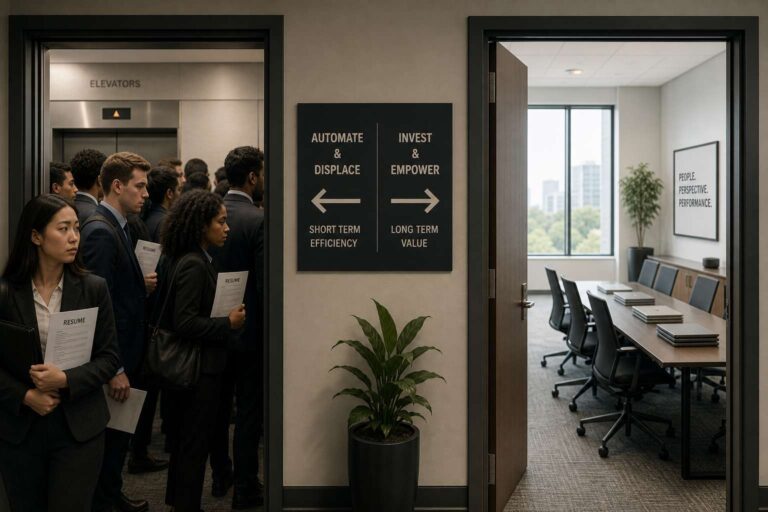
Artificial Intelligence-related job cuts accounted for 26% of all U.S. layoffs in April, or 21,490 of 88,387 total, marking the second consecutive month the technology was the top driver of workforce reductions. A Gartner survey of 350 executives found that roughly 80% of companies using Artificial Intelligence agents or autonomous technologies are cutting staff as a result. Some employers are openly tying restructuring to Artificial Intelligence adoption: Coinbase is cutting 14% of its workforce, PayPal plans to reduce headcount 20% over the next two to three years, and Cloudflare is laying off more than 1,100 employees globally. Other companies are taking a different approach. Spotify is holding headcount flat, Axon told its 5,000-plus employees that Artificial Intelligence would not trigger layoffs, and IBM expects to employ more people in three years as workers shift into new roles.
Artificial Intelligence is also changing hiring practices on both sides of the labor market. 74% of companies report that candidates are now using Artificial Intelligence in their job searches, while only 18% say they are using Artificial Intelligence broadly across their own hiring workflows. Among more than 400 U.S. talent acquisition leaders surveyed, 69% said their companies use Artificial Intelligence in some capacity, with screening at 58%, candidate communication at 54%, assessments at 50%, and sourcing at 46%. Recruiters override Artificial Intelligence recommendations in 58% of organizations, while 82% say transparency and explainability matter and 45% still lack a formal governance framework. Employers are responding to what they describe as “skillfishing” by adding stricter skills verification and more rigorous pre-screening.
Pressure is building most sharply at the entry level. The unemployment rate for recent college graduates ages 22 to 27 reached 5.6% in the first quarter of 2026, above both the 4.2% overall rate and the 3.1% rate for all college-educated workers. Oxford Economics estimates that 85% of the rise in the unemployment rate since mid-2023 is concentrated in new labor market entrants who cannot find work, while hiring in tech, finance, and professional services remains 20% to 30% below pre-pandemic pace. A Stanford study found a 16% decline in early-career employment across the most Artificial Intelligence-exposed occupations since late 2022, and software development job postings have fallen 53% over the same period. Only 10% of employers surveyed said recent graduates are sufficiently prepared for Artificial Intelligence-enabled workplaces.
Employer decision-making is under strain beyond staffing levels. A Harvard Business Review experiment found that when Artificial Intelligence was framed as an employee rather than a tool, personal accountability among managers fell by 9 percentage points and reviewers caught 18% fewer errors. Requests for additional managerial review jumped 44%, suggesting that anthropomorphizing the technology weakens oversight rather than improving trust. At the policy level, states including Virginia, Colorado, and New Jersey are advancing new employer requirements, while federal scrutiny of workplace diversity programs is rising through high-profile EEOC actions against The New York Times and Nike.