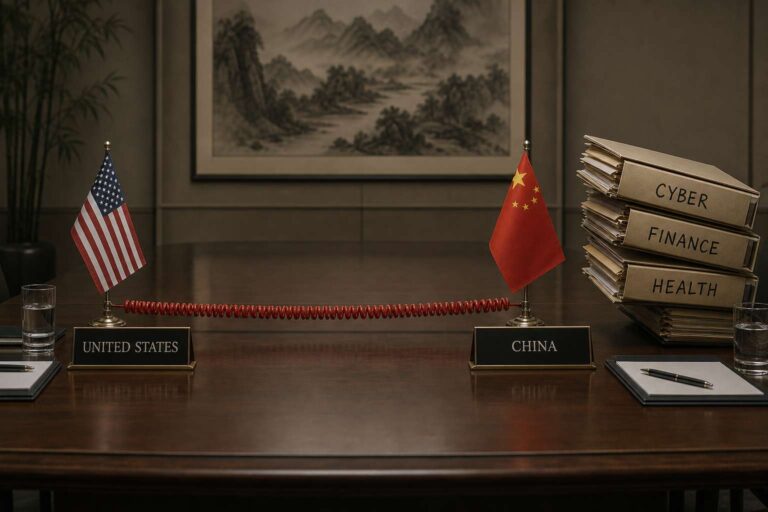
Washington and Beijing are exploring renewed talks on an emergency communication channel for Artificial Intelligence ahead of President Trump’s state visit to China. The discussions mark a sharp change in posture after earlier efforts stalled amid distrust, export control disputes and divergent views on the risks posed by advanced systems. Concern has intensified in recent weeks after the debut of Mythos, Anthropic’s new model, which officials and industry figures see as having extraordinary cyber capabilities that could threaten government databases, financial institutions and healthcare programs.
The current opening builds on a fragile foundation established during earlier diplomacy. Three years ago, leaders from both countries endorsed the idea of a dedicated emergency line for Artificial Intelligence matters. Talks formally began in 2024 in Switzerland, but Chinese officials reportedly treated U.S. warnings about runaway Artificial Intelligence as abstract and redirected discussion toward American export restrictions. Even so, both governments reached an accord in November of that year in Peru to keep Artificial Intelligence out of the command and control of nuclear weapons, creating a limited precedent for cooperation despite broader rivalry.
The two sides approach the technology from notably different strategic assumptions. Major U.S. companies are racing toward artificial general intelligence, or AGI, pursuing the idea that the first system to reach that threshold could improve itself recursively and pull far ahead of rivals. Chinese companies, by contrast, are described as following a state-backed strategy centered on applying Artificial Intelligence across industries such as manufacturing, humanoid robotics and the internet of things rather than focusing primarily on a single AGI breakthrough. That difference has fed mutual suspicion, with some in Washington doubting Beijing’s stated priorities and some in China viewing U.S. regulatory proposals as an attempt to constrain Chinese progress.
American officials and researchers also believe China enters any negotiations from a weaker technical and financial position, though not without leverage. OpenAI is valued at something near ? billion. Leading Chinese companies that have gone public are valued at ? billion. U.S. officials are also worried that China may narrow the gap through model distillation and other forms of technology extraction. Last month, a White House Office of Science and Technology Policy memo accused Chinese actors of “industrial-scale campaigns to distill U.S. frontier AI systems,” allowing advanced models to be replicated “at a fraction of the cost,” while removing carefully designed safety protections.
Any return to formal talks would face resistance on both geopolitical and domestic grounds. Many U.S. policymakers still see Artificial Intelligence as a winner-takes-all contest, while Silicon Valley remains divided over regulation. Inside the Trump administration, concern rose after meetings with major banks and after Anthropic raised alarms about Mythos. Officials are now weighing narrower, risk-specific agreements rather than a sweeping regime. Experts see potential areas for cooperation in cyber risk, proliferation and military use, but verification and trust remain major obstacles between the world’s two leading adversaries.