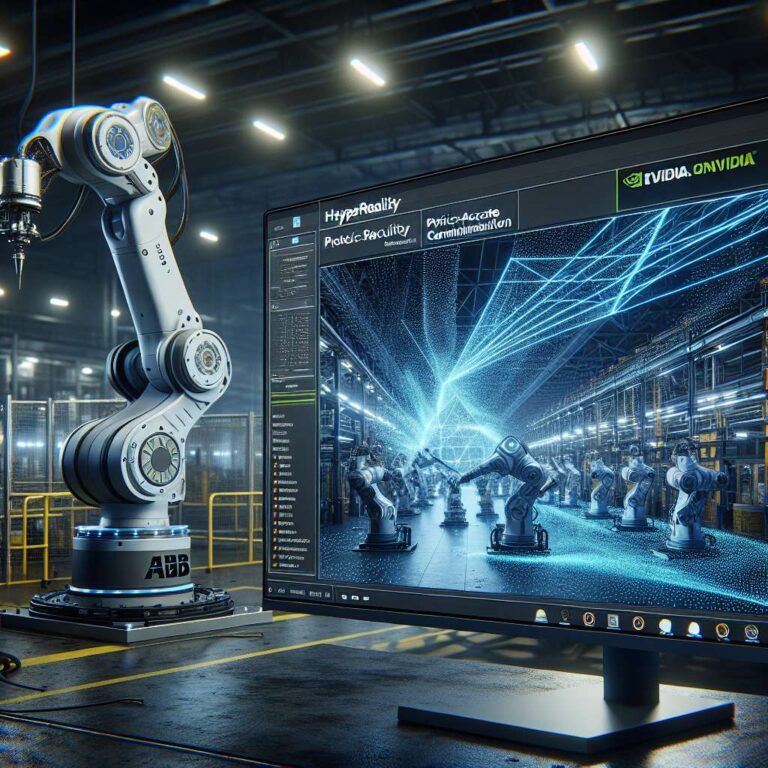
ABB Robotics is partnering with NVIDIA to bring industrial-grade physical artificial intelligence to factory automation by embedding NVIDIA Omniverse libraries directly into ABB’s RobotStudio programming and simulation suite. The integration underpins a new product, RobotStudio HyperReality, which is designed to deliver physically accurate, photorealistic simulation capabilities that can dramatically cut engineering time, reduce deployment costs by up to 40% and accelerate time to market by as much as 50%. RobotStudio HyperReality will be available in the second half of 2026 and is already attracting interest from major manufacturers such as Foxconn and robotic workforce startup Workr.
The combined platform allows more than 60,000 robotics engineers using RobotStudio to design, program, test and validate entire automation cells virtually before any physical robot is installed. RobotStudio HyperReality exports a fully parameterized robot station, including robots, sensors, lighting, kinematics and parts, as a USD file into NVIDIA Omniverse, where ABB’s virtual controller runs the same firmware as the physical robot to enable 99% correlation between simulation and real-world behavior. Synthetic images generated in Omniverse feed directly into artificial intelligence training pipelines so vision models can be trained entirely in simulation, while ABB’s Absolute Accuracy technology reduces positioning errors from 8-15 mm to around 0.5 mm to improve precision. Manufacturers can use this environment to cut setup and commissioning times by up to 80% and eliminate physical prototypes, addressing long-standing simulation limitations such as mismatched lighting, material behavior and model robustness.
Early pilots illustrate how the partnership aims to close the sim-to-real gap at scale. Foxconn is testing HyperReality for consumer electronics assembly, where delicate metal components and fast-changing product designs complicate automation, using synthetic data to train robots virtually and expecting to reduce setup time and avoid costly physical testing. Workr is integrating its WorkrCore physical artificial intelligence platform with ABB industrial robots trained with synthetic data generated using NVIDIA Omniverse libraries, targeting small and medium-size manufacturers with systems that can onboard new parts in minutes and deploy without programming expertise. ABB Robotics is also exploring integration of the NVIDIA Jetson edge artificial intelligence platform into its Omnicore controller to enable real-time inference across its robot portfolio, positioning the collaboration as a foundation for more reliable and scalable artificial intelligence driven robotics in industrial environments.