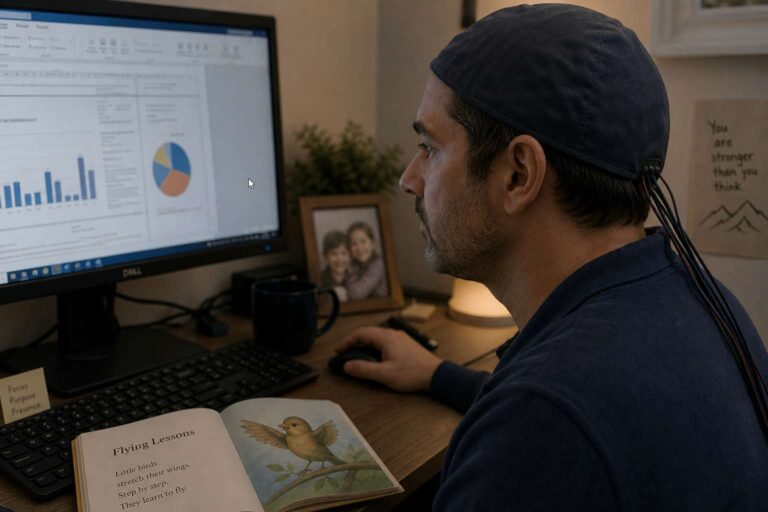
Casey Harrell has used a brain-computer interface to regain a measure of communication and independence while living with ALS. Harrell has had a set of electrodes embedded in his brain for almost three years, and he first used the system to speak sentences with the help of a research team in 2023. Since then, he has logged thousands of hours using the device at home, including for web browsing, messaging, and work as an environmental activist.
Within the first 22.6 months after the device was implanted, Harrell had used it for more than 3,800 hours at home without any researchers present, according to the team’s Nature Medicine report. In July 2023, during a five-hour operation, doctors implanted four arrays of 64 electrodes each into his brain. Each pair of arrays was wired to a pedestal connection point, creating two docking locations on the exterior of his skull to connect the electrodes to a computer.
The system records activity from the speech motor cortex and maps attempted speech into sounds and words. There are 39 phonemes that make up all the sounds in the American English language, according to Nicholas Card of UC Davis. The team started using the device around a month after the surgery. On that day in August, Harrell used the device to speak with a 50-word vocabulary, and 99.6% of the words were as he had intended. That vocabulary was later expanded to 125,000 words with 97.5% accuracy.
Harrell can now use the device with less direct involvement from the research team after more of the system was automated. A care partner can connect and disconnect the equipment, allowing Harrell to begin using it after being plugged in. The system is now 99% accurate, according to Sergey Stavisky, and Harrell can control a cursor to send texts and emails, browse online, and perform job-related tasks. New software features include a privacy mode that automatically deletes decoded text and an optional profanity filter for conversations around his young daughter.
Researchers and outside experts cautioned that the same results may not generalize to every person with ALS, especially because long-term implant performance can vary and some patients may avoid invasive surgery. Harrell described the system as transformative for work, family life, and parenting. With his seven-year-old daughter, he said he can now read and help build her reading skills, while sharing more parenting responsibilities with his wife.