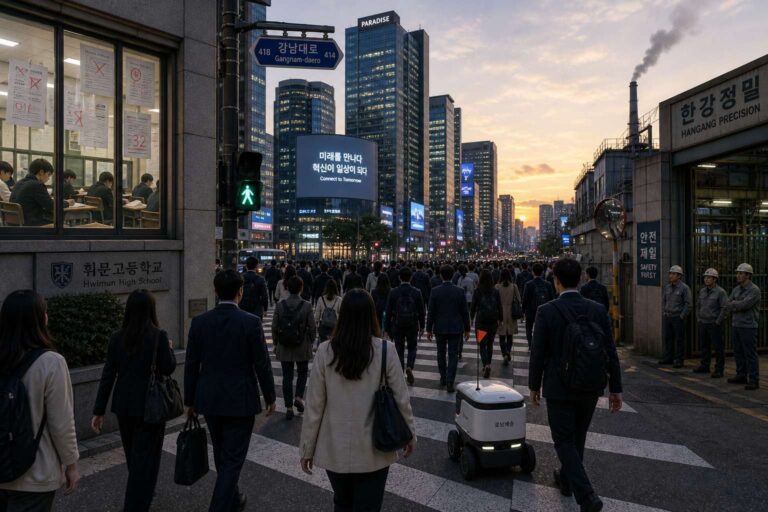
South Korea has become one of the world’s most enthusiastic adopters of Artificial Intelligence, with everyday life in Seoul already shaped by unmanned immigration checkpoints, real-time transit screens, delivery robots, digital classrooms, and chatbot use. Only 16% say they are more concerned than excited about Artificial Intelligence, the lowest of any of the 25 countries surveyed by the Pew Research Center, while 50% of Americans were more worried than excited. A majority of Koreans use Artificial Intelligence every day, either as a sort of personal assistant or to do tasks at work, according to surveys by the Ministry of Culture, Sports, and Tourism and Korea Chamber of Commerce and Industry.
The country’s optimism is closely tied to a national strategy that casts Artificial Intelligence as a driver of economic growth and global influence. South Korea’s government has promoted an Artificial Intelligence-powered Fourth Industrial Revolution as a path forward, reinforcing a broader belief that technological adoption is central to national modernization. In the 1970s, South Korea manufactured steel and ships, then semiconductors in the 1980s, broadband in the 1990s, and smartphones in the 2000s. Today, Samsung and SK Hynix supply most of the world’s high-bandwidth memory chips used in advanced Nvidia hardware for training Artificial Intelligence models.
President Lee Jae-myung has pledged to vault the country into the ranks of the “top three Artificial Intelligence powers” alongside the US and China. After taking office in 2025, he launched the Presidential Council on National Artificial Intelligence Strategy and a sovereign Artificial Intelligence foundation model project that funds Korean companies to develop homegrown models. In 2024, South Korea’s legislature passed the Artificial Intelligence Basic Act, one of the world’s first comprehensive Artificial Intelligence laws, to promote development and establish light-touch regulatory guardrails. Seventy percent of South Koreans say advancing science and medicine through Artificial Intelligence innovation is a bigger priority than protecting industries through regulation, according to the 2026 Stanford Artificial Intelligence Index. The same index ranked South Korea as having the third largest number of notable Artificial Intelligence models in the world, based on criteria such as state-of-the-art advancements or high citation rates.
The rapid push also exposes blind spots. In 2025, the South Korean government faced a fierce backlash for rolling out Artificial Intelligence textbooks riddled with factual inaccuracies and data privacy risks without testing them first in a pilot program to evaluate how they affect student learning. Workers are also anxious about automation, especially after Hyundai announced plans to deploy Atlas humanoid robots across its car factories. Sixty-four percent of South Koreans fear Artificial Intelligence could displace human labor and exacerbate inequality, although 52% believe it could also increase productivity. Chatbots have even entered personal rituals: 46% of South Koreans in their 20s have used a chatbot to read their fortunes, according to a survey by Korea Gallup.