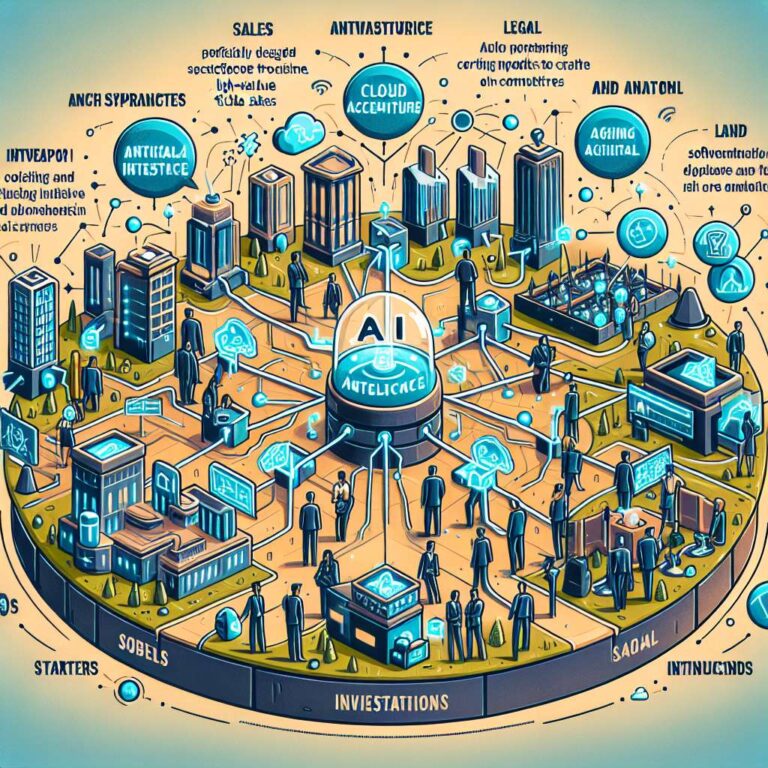
Vertical Artificial Intelligence agents are emerging as a new focus for startups building software for specialized industries and workflows. Unlike general purpose models that can generate text, write code, or summarize reports, these agents are designed to do one job exceptionally well by combining models with domain-specific data, workflows, and context. Companies including Nooks, Supio, Prophetic, Gradial, and Pulumi are using the approach to automate work that extends beyond traditional software-as-a-service products and into execution inside operational systems.
Nooks illustrates how quickly the shift is happening. Just a year ago, the sales startup relied more heavily on prompts and pre-trained models, but now it has embedded agents across much of its product stack. Its agents handle end-to-end sales workflows, including identifying accounts, finding contacts, drafting emails, and helping representatives on live calls. Supio is applying a similar concept to legal work, using Artificial Intelligence to turn complex data such as medical records into verified, structured outputs that attorneys can trust. Prophetic trained its system on more than 20,000 municipal zoning codes in the U.S., aiming to remove bottlenecks in land acquisition intelligence.
Investors are increasingly drawn to the category. Mia Lewin recently raised an inaugural 5 million fund for TheFounderVC, a firm focused on vertical Artificial Intelligence startups. She said, “We expect this space to mint over 300 unicorns in the next decade, with the first Vertical AI IPOs hitting the market within three years.” Investors at Madrona and Bessemer Venture Partners also see specialized companies gaining advantage by solving hard domain-specific problems and by tapping directly into labor costs rather than only information technology budgets.
Building effective vertical agents requires more than access to a model. Operators describe the need for an “agent harness,” or infrastructure that can orchestrate tasks, retrieve context, and verify outputs. Pulumi’s Neo, for example, helps automate cloud infrastructure work such as cost optimization and compliance while operating across complex systems. Joe Duffy said the depth of a vertical agent comes from understanding a domain that is “much more complex” than model tokens alone. Startups also see proprietary contextual data as a competitive edge, especially when incumbents have large amounts of data but less clarity about its quality and relevance.
The next stage of development is moving toward networks of collaborating agents and more proactive systems that can initiate actions rather than only respond to prompts. Even so, companies are still cautious about how much authority to delegate. Low-risk tasks may be handled autonomously, while high-stakes decisions still require human oversight. Some leaders also expect these systems to reshape organizational structure. At Pulumi, Duffy said engineers who can direct teams of agents are becoming dramatically more productive, while Arm executive Sharbani Roy framed agents as apprentices that help employees make better decisions and exercise higher judgment.