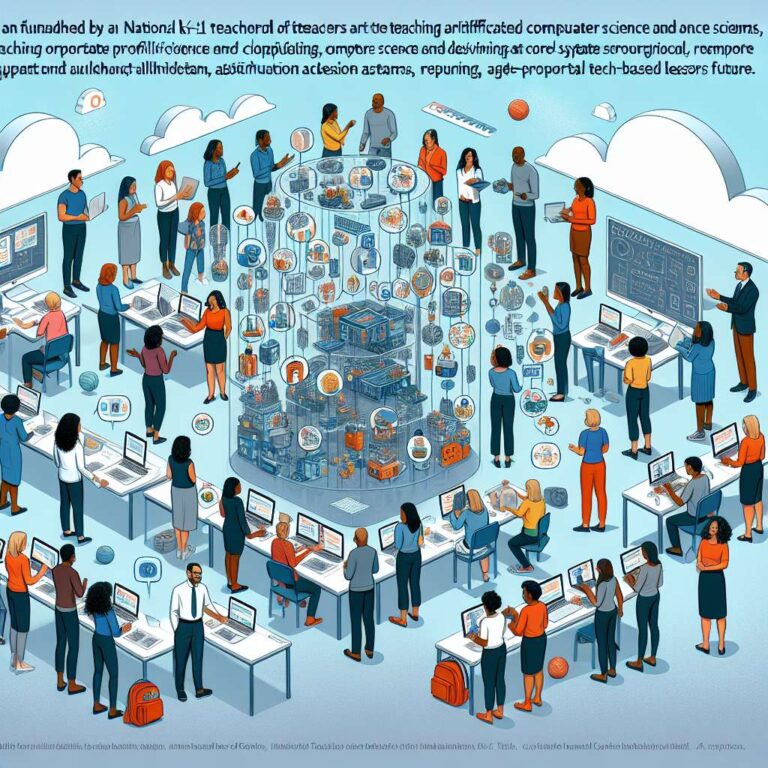
The U.S. National Science Foundation announced an 11 million award to the Computer Science Teachers Association in support of the executive order on “Advancing Artificial Intelligence Education for American Youth.” The funding will launch Artificial Intelligence Professional Development Weeks: CS Foundations for Creating with Artificial Intelligence, a multistate effort aimed at preparing K-12 educators to teach foundational computer science and Artificial Intelligence at scale.
Over the next two years, Artificial Intelligence PD Weeks will operate in Indiana, South Carolina, Minnesota, New Jersey, Iowa, Illinois and at least three additional states. The project will directly support approximately 2,500-3,000 teachers. Based on conservative estimates of 200 students per teacher, this investment is expected to expand enhanced Artificial Intelligence and CS learning opportunities to 500,000-600,000 students.
The program combines intensive, strand-based summer professional development with sustained community support through established state and local networks. NSF said this structure is intended to create scalable infrastructure for rapidly expanding Artificial Intelligence teaching capacity while maintaining instructional quality. Participating teachers are expected to deepen their understanding of core CS concepts including data, algorithms, abstraction and systems, and to build confidence in designing age-appropriate lessons and projects in which students use, build and critique Artificial Intelligence systems.
The initiative also aims to expand classroom integration of Artificial Intelligence-related content across computer science courses and, where appropriate, other subject areas. A research component will examine how teachers integrate Artificial Intelligence concepts, tools, and ethical considerations into instruction when backed by intensive professional learning and sustained community support.
NSF and CSTA framed the investment as part of a broader effort to strengthen educator preparation, expand the domestic talent pipeline, and improve student readiness for a technology landscape increasingly shaped by Artificial Intelligence. The initiative is intended to build instructional expertise nationwide so students develop practical skills and foundational knowledge that can support future work across industries and careers.