
USMCA Loophole Lets Taiwan-Made GPUs Bypass Trump Tariffs

A USMCA technicality allows Taiwan-made GPUs to avoid hefty import tariffs by routing them through Canada or Mexico for final assembly, offering a major boost to Artificial Intelligence supply chains.

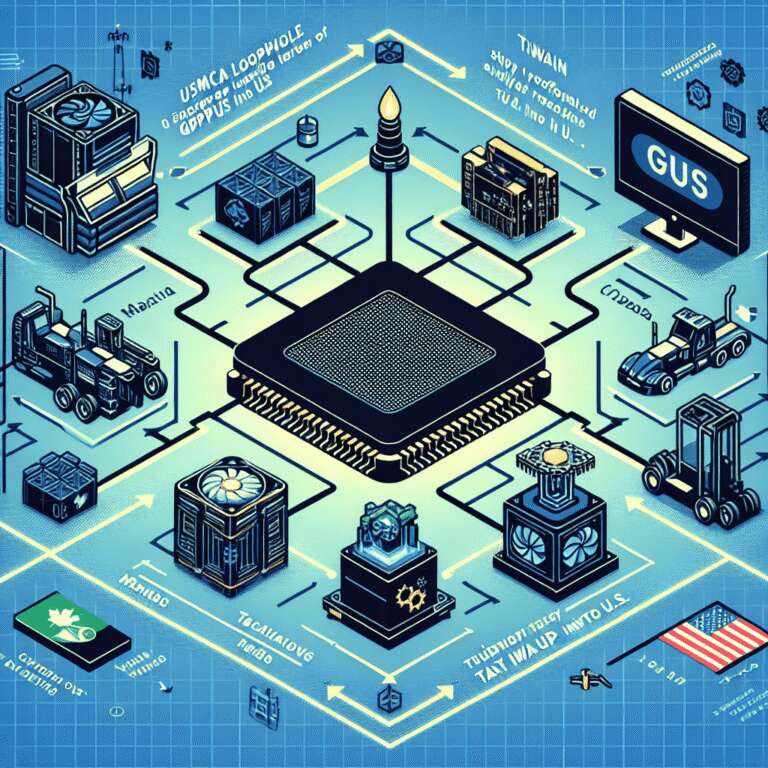
A recently identified loophole in the United States-Mexico-Canada Agreement (USMCA) allows high-performance GPUs manufactured in Taiwan to enter the US market without incurring the 32% import duties imposed on direct shipments from Taiwan. This workaround, uncovered by research firm SemiAnalysis, enables technology companies to route these Taiwan-made GPUs through assembly operations in Mexico or Canada. Once these GPUs undergo final assembly in North American facilities, they qualify for tariff exemptions under specific Most-Favored-Nation clauses within the USMCA.

The legal foundation of this exemption lies in the USMCA’s broadened classification of what constitutes an ´originating good.´ Under harmonized tariff schedule codes HTS 8471.50 (digital processing units), HTS 8471.80 (automatic data processing machine units), and HTS 8473.30 (associated components), products are treated as North American in origin regardless of where their main components were manufactured. This creates a path for NVIDIA’s HGX boards, GB200 baseboards, and RTX graphics cards to avoid high tariffs when shipped to the US if final assembly occurs in Canada or Mexico, rather than in the country of origin.

This strategy builds on two recent policy directions. First, President Trump´s March 7 executive orders preserved the USMCA’s established duty-free status for goods from Canada and Mexico. Second, the USMCA’s inclusive definition of originating products allows technology companies to structure their logistics in a way that counters the impact of trade tensions. Although this approach increases the complexity of global supply chains, especially for US technology firms focused on Artificial Intelligence workloads, the elimination of steep import duties justifies the logistical shifts. The move echoes long-standing precedents in agricultural trade, where products gain tariff exemptions through partial processing or assembly in North American Free Trade partners´ territories. As the global supply chain adapts, the effectiveness and breadth of this loophole´s use remain to be seen, especially amid evolving international trade policies targeting advanced computing hardware.
65

Impact Score

Congress weighs Artificial Intelligence transparency rules

Bipartisan lawmakers are pushing a federal transparency standard for the largest Artificial Intelligence models as Congress works on a broader national framework. The proposal aims to increase public trust while avoiding stricter state-by-state requirements and heavier regulation.

Report finds California creative job losses are not driven by Artificial Intelligence

New research from Otis College of Art and Design finds California’s recent creative industry job losses stem from cost pressures and structural shifts, not direct worker displacement by generative Artificial Intelligence. The technology is changing workflows and expectations, but it is largely replacing tasks rather than entire jobs.

U.S. senators propose broader chip tool export ban for Chinese firms

A bipartisan proposal in the U.S. Senate would shift semiconductor equipment controls from specific fabs to targeted Chinese companies and their affiliates. The measure is aimed at cutting off access to advanced lithography and other wafer fabrication tools for firms such as Huawei, SMIC, YMTC, CXMT, and Hua Hong.

Trump executive order targets state Artificial Intelligence laws

Executive Order 14365 lays out a federal strategy to discourage, challenge, and potentially preempt state Artificial Intelligence laws viewed as burdensome. Employers are advised to keep complying with current state and local rules while preparing for regulatory uncertainty in 2026.

Who decides how America uses Artificial Intelligence in war

Stanford experts are divided over how the United States should govern Artificial Intelligence in defense, surveillance, and warfare. Their views converge on one point: decisions with such high stakes cannot be left to companies alone.

Contact Us

Got questions? Use the form to contact us.

Contact Form

Clicking next sends a verification code to your email. After verifying, you can enter your message.