China’s technology security authorities certified nine domestically designed Artificial Intelligence processors for state procurement, establishing a new “Artificial Intelligence training and inference chips” category under the Anke security certification framework. The approved products include Huawei’s Ascend 310 and Ascend 910 processors, Alibaba’s T-Head Zhenwu M530 and M890, and chips from Biren Technology, Hygon Information Technology, Iluvatar CoreX, MetaX, and Moore Threads. Cambricon Technologies and Baidu-backed Kunlunxin were not included.
The certifications are valid for three years and were issued jointly by the China Information Technology Security Evaluation Centre and the National Secrecy Science and Technology Evaluation Centre. Their approvals act as a procurement catalog for government agencies, central state-owned enterprises, and other organizations covered by Beijing’s Xinchuang initiative, which is aimed at replacing Western hardware and software in sensitive Chinese information technology systems. The move extends a program that had previously concentrated on swapping out Intel and AMD CPUs and Oracle databases.
The latest approvals mark a significant expansion from the earlier phase of China’s domestic Artificial Intelligence hardware certification effort. In December, Beijing added only Huawei and Cambricon to the Xinchuang procurement list for Artificial Intelligence processors. Five months later, seven vendors now hold Anke security certification for nine separate chips. Cambricon’s absence is notable because it appeared on the December list and is targeting 500,000 Artificial Intelligence chip shipments in 2026, although an anonymous source said companies can decide whether to submit products for testing. Each chip must pass tests under the Anke V3.0 requirements to qualify.
Chinese chipmakers continue to gain ground in the domestic market as pressure on Nvidia persists. Chinese semiconductor firms delivered 1.65 million Artificial Intelligence GPUs in 2025 out of a total of 4 million units, claiming 41% of local Artificial Intelligence server shipments. Huawei alone shipped roughly 812,000 Artificial Intelligence chips and is projecting ? billion in Artificial Intelligence processor revenue for 2026. Morgan Stanley estimates China’s total Artificial Intelligence chip market could reach ? billion by 2030, with domestic supply covering roughly 76% of demand.
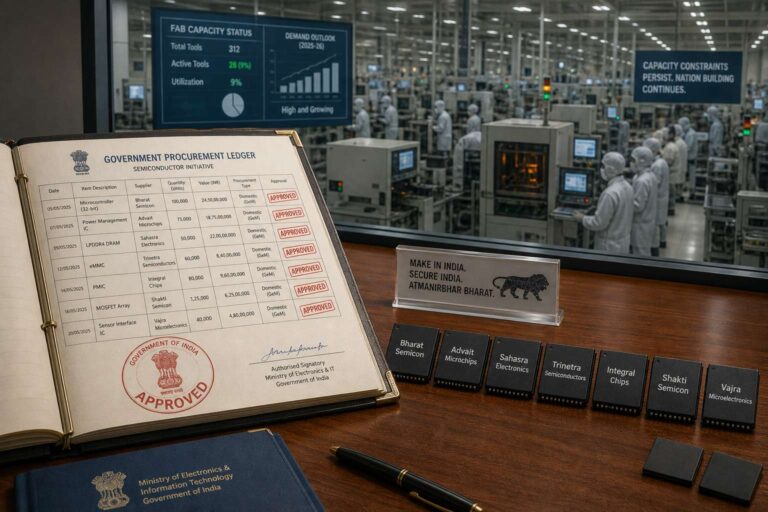
Manufacturing capacity remains a constraint. All of the certified chipmakers are competing for limited production capacity at SMIC, whose most advanced stable node is its N+2 process, which is roughly equivalent to 7nm. SMIC reported overall utilization rates above 93% for 2025 and spent ?.1 billion in capex last year, with plans to hold that level through 2026.