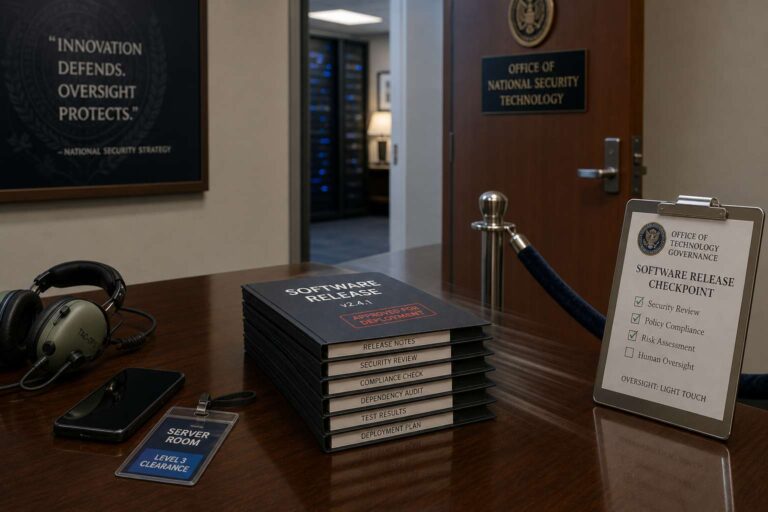
President Donald Trump signed a new Artificial Intelligence executive order on Tuesday, less than two weeks after scrapping an earlier directive. The policy is framed around innovation and security and marks a turning point in White House governance of Artificial Intelligence. It is also likely to draw criticism from both opponents and supporters of stricter regulation, reflecting tensions over how far federal oversight should go.
The order creates a voluntary review system in which tech companies will be asked to share frontier models with the government for review 30 days before they plan to release them. It does not impose mandatory licensing, and the government will not require permits before software can be deployed. It also establishes a dedicated Artificial Intelligence cybersecurity clearinghouse, a new hub designed to coordinate security checks with the private sector.
The new directive is a reduced version of the order Trump shelved last month. The earlier version requested models 90 days before their release, making the new timeline less demanding for companies. Even so, the move still represents stronger Artificial Intelligence oversight than the White House had previously embraced, signaling a clear break from a more hands-off approach.
The briefing also spotlights Anduril and Meta’s work on an augmented-reality headset for the military. Anduril shared new details on a prototype that includes a vision of ordering drone strikes through eye-tracking and voice commands. Quay Barnett, who leads the effort at Anduril after a career in the Army’s Special Operations Command, described a system intended to optimize “the human as a weapons system,” with drones and soldiers sharing information and making decisions together.
Other items in the roundup point to a wider technology agenda shaped by surveillance, platform power, and infrastructure strain. Meta has scaled back plans to track workers’ clicks and keystrokes to train Artificial Intelligence, while Microsoft faces scrutiny over internal ambitions for a new assistant. Concerns also surfaced about Artificial Intelligence in mathematics, cybercrime, and computer security, while Google’s search features, US data center delays, global electric-vehicle pricing, and Europe’s effort to reduce dependence on US technology companies rounded out the day’s developments.