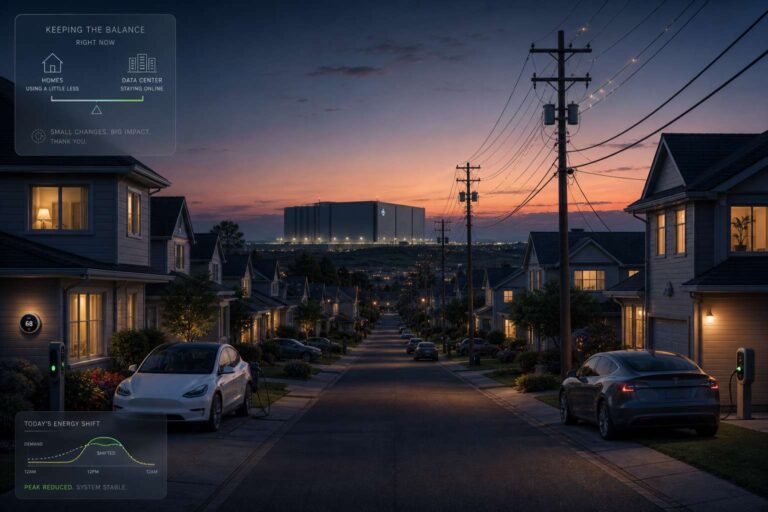
Google has signed a deal with Voltus to help pay for a virtual power plant in PJM, the grid that covers much of the US East Coast. Voltus will group together devices like electric vehicles and smart thermostats, pay customers to participate, and reduce power use or tap stored energy when the grid is stressed. Google will fund the setup, and the added capacity from the project is intended to help run its data centers in the region.
The agreement is one of the clearest examples so far of a tech company using a virtual power plant to help meet rising electricity demand from data centers. Interest in this idea has grown alongside broader discussion of data center flexibility. A study from Duke University found that if data centers agreed to decrease their energy demand for roughly 40 hours per year, about 100 gigawatts’ worth could come online without making new power plants or transmission equipment necessary. The logic is that the grid is built to handle moments of peak demand, so lowering consumption during those periods can create room the rest of the year.
Questions remain about how much flexibility data centers can realistically offer, especially as Artificial Intelligence use expands. Training a model may be delayed or shifted, but customer demand is less flexible, and reducing computing capacity could mean lost revenue. Policymakers are exploring ways to address that. One proposal in the US would allow new data centers to come online years sooner if they agree to lower demand when the grid is nearing its max. A new Texas law also requires large users to switch to backup power or curtail their demand in emergency situations.
Voltus announced in September a program called “Bring your own capacity,” which allows data centers to finance flexibility on their local grid, and Google is the first named customer. Under the new agreement, the company says it will be able to aggregate up to 100 megawatts of distributed energy resources each year. The plant should be operational in 2027, according to Voltus. Google has also made other agreements with utilities across the US to limit or shift its own energy demand, though the company has acknowledged that not every facility can ramp down power use.
The bigger uncertainty may be whether customers will participate in enough numbers. A recent California study on managed electric-vehicle charging found that with no economic incentive, only 1% of EV owners enrolled in managed charging. At ? per month (about 15% of their power bill), only 4.6% did. The companies have not disclosed what they plan to pay participants in this project. That matters because even when money is offered, people may still resist giving up control over electricity use, particularly as about 70% of Americans oppose Artificial Intelligence data centers in their area, according to recent Gallup polling.