
Nvidia pushes Artificial Intelligence PCs into the mainstream

Nvidia is positioning Artificial Intelligence PCs as a new phase for personal computing, with Jensen Huang arguing that the category could reshape how laptops and desktops handle demanding software. The shift centers on running more Artificial Intelligence features directly on devices instead of depending heavily on the cloud.

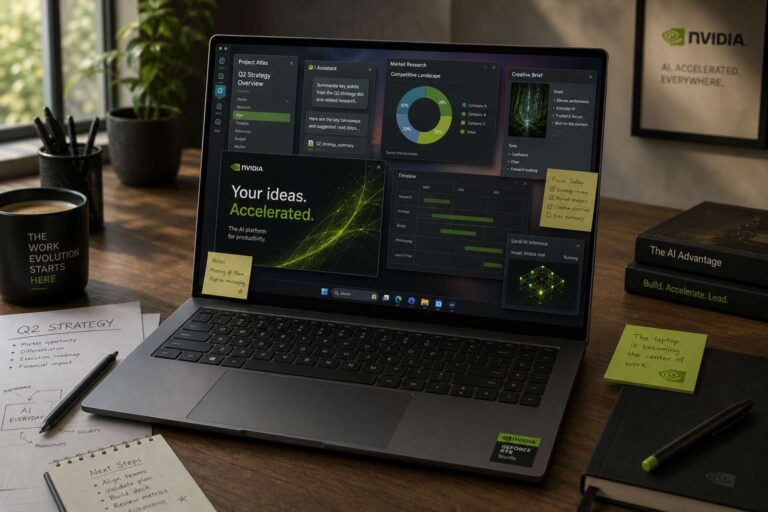
Nvidia is moving into the PC chip market and framing Artificial Intelligence PCs as a major change in personal computing. Jensen Huang has said the company is partnering with Microsoft to reimagine the computer for Artificial Intelligence, casting the transition as a break from the traditional productivity-focused PC model.

Artificial Intelligence PCs are designed to run Artificial Intelligence tasks directly on laptops and desktop computers without relying as heavily on cloud infrastructure. Manufacturers say these systems can process data faster than traditional ones and can handle a larger volume of Artificial Intelligence tasks directly on the device, including chatbots. The focus is on placing Artificial Intelligence capabilities inside the computer itself rather than treating them as services that mostly run elsewhere.

Nvidia has increased attention on the category by launching a new chip aimed at bringing Artificial Intelligence capabilities directly into consumer computers. Huang has described the moment as the first reinvention of the PC in 40 years, arguing that every device can become an intelligent agent platform. That message aligns Nvidia with Microsoft in a broader effort to define a new computing paradigm centered on built-in Artificial Intelligence performance.

The push comes as demand for Artificial Intelligence PCs remains mixed in the market. Even so, Nvidia is betting that on-device processing, faster performance, and the ability to support more advanced Artificial Intelligence workloads will make the category more important over time. The company is using its expansion into PC chips to position itself at the center of that transition.
52

Impact Score

Nvidia unveils RTX Spark Windows PCs

Nvidia introduced RTX Spark, its first fully integrated chip for Windows laptops and desktops, aiming to bring local Artificial Intelligence agents, gaming, and productivity workloads onto its own hardware stack. The new systems are expected this fall from major PC makers, with premium pricing and no detailed benchmarks yet disclosed.

NVIDIA launches RTX Spark for personal computers

NVIDIA introduced the RTX Spark, a new Artificial Intelligence personal computer chip that pushed Intel, AMD, and Qualcomm shares lower while lifting Arm and NVIDIA. The launch signals a direct challenge to the processors that have long defined the personal computer market.

UK and Australia sign Artificial Intelligence security memorandum

The UK and Australia have agreed to deepen cooperation on Artificial Intelligence security and safety through a new memorandum between their respective institutes. The partnership focuses on frontier systems, cyber risks, research sharing, and testing practices.

Financial institutions adopt transaction foundation models

Financial institutions are shifting from fragmented task-specific systems to transaction foundation models trained on proprietary data. The approach is gaining traction as firms seek a unified view of customer behavior across fraud, credit, payments and personalization.

Illinois Senate advances frontier Artificial Intelligence bill

Illinois lawmakers advanced a bill aimed at the most powerful Artificial Intelligence models, with new transparency, auditing and risk reporting requirements for the largest developers. Supporters call it a modest but important baseline, while critics warn about compliance costs and unclear standards.

Contact Us

Got questions? Use the form to contact us.

Contact Form

Clicking next sends a verification code to your email. After verifying, you can enter your message.