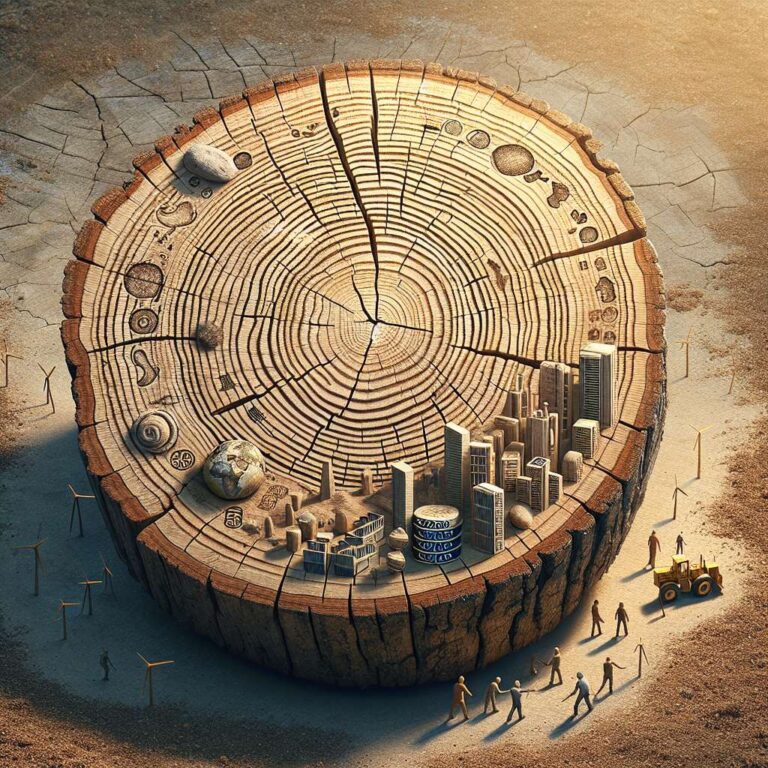
A vast chronological survey places humanity within a continuum stretching from the Big Bang singularity to the present. It begins with cosmic formation, the emergence of stars, the Milky Way, the Solar System, Earth, oceans and early chemistry associated with the origin of life. It then follows biological evolution through single-celled organisms, oxygenation, multicellular life, animals, plants, vertebrates, mammals, primates and hominins, presenting human existence as a very recent development in deep time.
The account traces the rise of Homo and the development of distinctively human behaviour through tools, fire, language, art, burial, clothing, seafaring and migration. It moves into agriculture, settlement and state formation, highlighting domestication, monumental architecture, writing, law, trade, empire, religion and science. Industrialisation and modernity are framed as accelerations in energy use, mobility, communication, computation and mechanisation. The timeline also marks milestones in medicine, democracy, war, infrastructure and digital systems, showing how social complexity expanded alongside technical power.
Recent centuries occupy a particularly dense section, with turning points in electricity, vaccination, computing, telecommunications, nuclear physics, the Internet and biotechnology. The text identifies 1986 as the point at which a useful deep learning algorithm signalled the birth of artificial intelligence, and notes 2020 as the year when protein structures were accurately predicted by an artificial intelligence network, AlphaFold. It also records 2022 as the debut of the first publicly accessible dialogue bot, the artificial intelligence language model ChatGPT, with implications for automation of cognitive labour, scholarship, creativity and model integrity.
The final section shifts from technological progress to planetary limits. It catalogues accelerating climate change, sea-level rise, glacier melt, ocean heating, biodiversity decline, wildfires, deforestation and plastic accumulation, presenting these as defining conditions of the present era. Global governance responses are threaded through the narrative, from biodiversity and climate agreements to sustainable development targets. Within that frame, the timeline marks 2024 as the year of the first comprehensive Artificial Intelligence law, the European Commission Artificial Intelligence Act, setting principles of safety and transparency to counteract deception and manipulation.
The closing perspective emphasizes scale and compression. Humans appear only near the end of a rescaled cosmic calendar, while agriculture, cities, industry and digital networks arrive in the final moments. That framing turns the timeline into both a record of accumulation and a warning about speed: cultural and technical advances have accelerated dramatically, but so have systemic environmental risks. The result is a portrait of the human condition as a story of emergence, invention, domination and growing responsibility for the future of Earth systems.