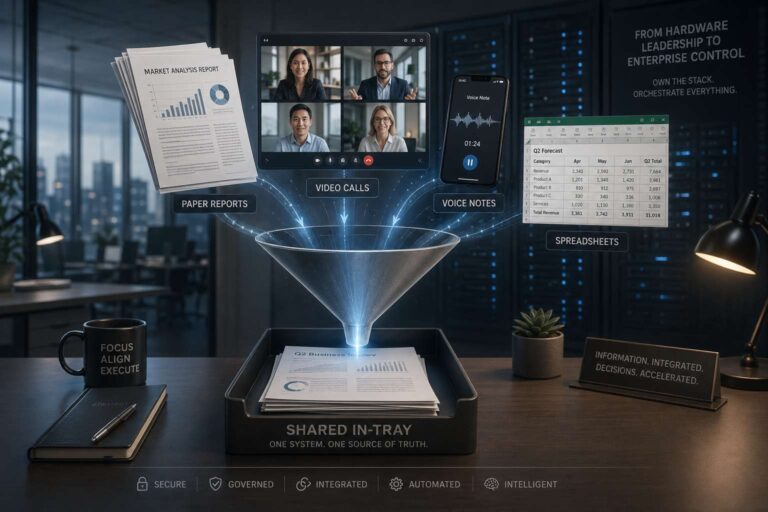
Nvidia has launched Nemotron 3 Nano Omni, a multimodal open model that combines vision, speech and language for enterprise agents. The model is intended to help organizations save time by enabling agents to deliver faster, smarter responses through reasoning across modalities. It removes the need for separate perception models for video, audio, image and text, and is the latest version in Nvidia’s open source Nemotron family.
Nemotron 3 Nano Omni combines vision and audio encoders within its 30B mixture-of-experts architecture. Nvidia said this design gives the system higher throughput than its other Omni models, which in turn supports lower costs and better inference efficiency. The model can work alongside proprietary models and other Nemotron open models in agentic workflows including computer use agents, document intelligence, and audio and video understanding. In computer use scenarios, it powers the perception loop for agents navigating a computer screen and reasoning about what appears on it. In document intelligence, it can interpret documents, charts, tables and screenshots while reasoning over visual and textual content together. For audio and video tasks, it maintains the context of both modalities within a single reasoning stream.
The launch also reflects Nvidia’s broader effort to extend its leadership in Artificial Intelligence hardware into models and services. The company remains dominant in hardware through its GPUs, but pressure is growing as major customers such as Google, Microsoft and AWS develop their own chips and increase production. Other customers, including OpenAI, are working with Nvidia rivals such as Cerebras and Broadcom, while some foreign customers, including DeepSeek, are moving toward local chipmakers such as Huawei. David Nicholson of Futurum Group said Nvidia’s largest customers are trying to reduce the hardware margins Nvidia currently enjoys, making software and model offerings an important strategic expansion.
Nvidia is positioning the model as part of a more integrated environment for enterprise agents, aiming to help them understand context across different types of data and infrastructure components. Nicholson said this approach could push enterprises toward a more intelligently engineered system that improves efficiency when Nvidia controls more of the stack. At the same time, questions remain about who the model is really for. It is unclear whether Nvidia is targeting a specific enterprise segment or whether hyperscale cloud providers with their own accelerators will adopt it widely. Nicholson said broad use outside the Nvidia stack is unlikely, even though Nvidia has released the model as open source with weights, training techniques and training sets.
Even so, the open source release may still encourage developer experimentation. Chirag Shah of the University of Washington said developers are likely to test and integrate the model into existing solutions, and successful use could strengthen Nvidia’s position as an infrastructure partner. That dynamic could help Nvidia build adoption for its non-hardware offerings even if deployment remains concentrated within its own ecosystem.