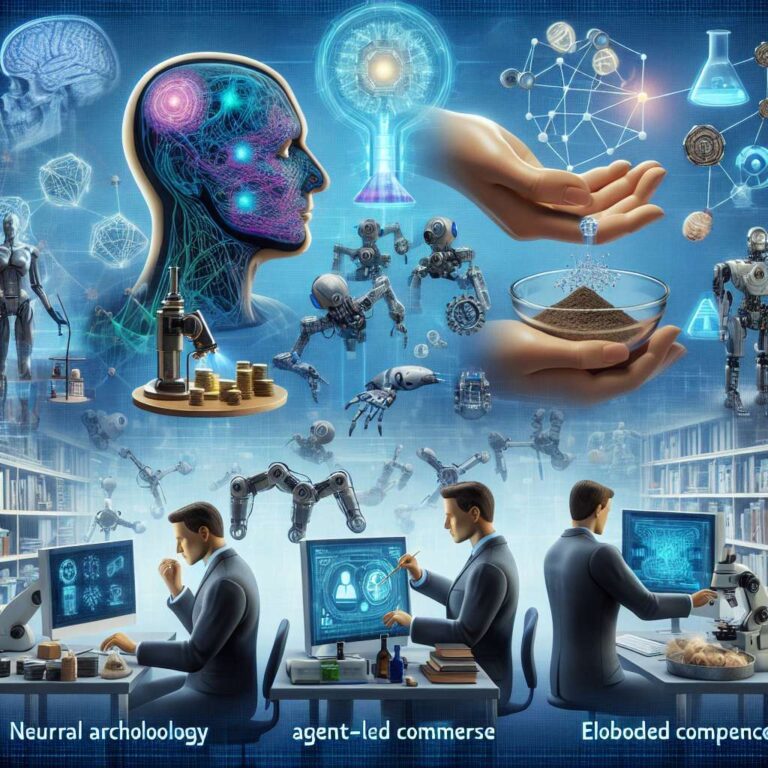
The article argues that by January 2027 three emerging directions in Artificial Intelligence will transform how societies relate to intelligent systems, not by incremental performance gains but by creating new kinds of autonomy in science, commerce, and robotics. The author, drawing on recent research and industry announcements, calls these shifts neural archaeology as scientific method, autonomous economic agency, and embodied physical competence. Across all three, humans increasingly set goals and constraints while Artificial Intelligence systems independently carry out complex reasoning, transactions, and physical tasks in ways existing institutional frameworks are not yet prepared to manage.
The first innovation, neural archaeology, describes Artificial Intelligence systems that systematically inspect their own internal representations to uncover new scientific principles, turning model interpretation into a primary research tool. Building on work at Stanford on “the archaeology of the high-performing neural nets” and studies such as “Paying attention to attention in proteins,” researchers are using techniques like sparse autoencoders to identify which features drive model performance, essentially reverse-engineering the model’s reasoning process to extract mechanisms in domains like protein science and materials research. The article imagines a drug lab where a neural archaeology report exposes three previously unknown protein binding mechanisms, and highlights real-world precursors such as the LUMI-lab system that evaluated over 1,700 lipid nanoparticles across ten iterative cycles and the Kosmos Artificial Intelligence scientist, where independent scientists found 79.4% of statements in Kosmos reports to be accurate, a single 20-cycle run performed the equivalent of 6 months of their own research time on average, and each run executes an average of 42,000 lines of code and reads 1,500 papers. The author contends the surprise is a new scientific epistemology in which insights emerge from studying how artificial neural networks process information rather than only using them as external tools.
The second innovation focuses on autonomous economic agency, where Artificial Intelligence agents evolve from shopping helpers into economically empowered actors that negotiate and transact on their own. Using Visa’s Trusted Agent Protocol as a starting point, the article notes that hundreds of secure, agent-initiated transactions have already been completed and that payment executives expect commercial use of personalized, secure agent transactions could arrive as early as the first quarter of 2026. The emergence of the x402 protocol, which revives HTTP’s 402 “Payment Required” code so agents can pay for API access in real-time, is presented as a turning point because it lets Artificial Intelligence agents autonomously purchase computational resources, data, and services. A scenario in Singapore depicts an Artificial Intelligence supply chain agent resolving a semiconductor disruption through dozens of machine-to-machine transactions in fourteen minutes, while Boston Consulting Group is cited as projecting the agentic commerce market could grow at an average annual rate of about 45 percent from 2024 to 2030. In the United Arab Emirates, Visa’s work with Aldar on agent-mediated payments for recurring fees is described as a precursor to household Artificial Intelligence agents that manage energy, contracts, and subscriptions within preset spending parameters. The author argues this marks a move from assisted commerce to delegated economic agency, raising unresolved questions about liability and consent when most routine transactions occur between machines.
The third innovation is a projected robot dexterity breakthrough driven by embodied foundation models trained on vast real-world interaction data rather than mechanical advances alone. The article cites Generalist Artificial Intelligence’s GEN-0, which is trained on orders of magnitude more real-world manipulation data than some of the largest robotics datasets that exist to date (as of Nov 2025), spanning settings from homes and bakeries to warehouses and factories, and is architected to capture human-level reflexes and physical commonsense. Drawing on academic reviews of embodied intelligence systems that integrate multimodal perception, world modeling, and structured strategies, the author argues that the real shift will come when training scale and model design allow robots to generalize across unstructured, dynamic environments. An imagined Rotterdam warehouse scene describes a robot sorting damaged, mixed cargo it has never seen before, using visual, tactile, and force feedback plus internal world models to avoid breakage or contamination, and a Shenzhen electronics factory example shows robots assembling custom circuit boards without task-specific programming. Research claiming that models such as LLMs and MLMs endow physical entities with strong generalization abilities is used to support the idea that by 2027 robots will reliably learn physical skills via the same scaling dynamics that drove language models, making the main bottleneck data and architecture rather than hardware. The conclusion ties these trends together, arguing that neural archaeology, agent-to-agent commerce, and embodied competence are converging toward Artificial Intelligence autonomy across scientific, economic, and physical domains, pressuring institutions to rethink peer review, financial regulation, and industrial quality control.