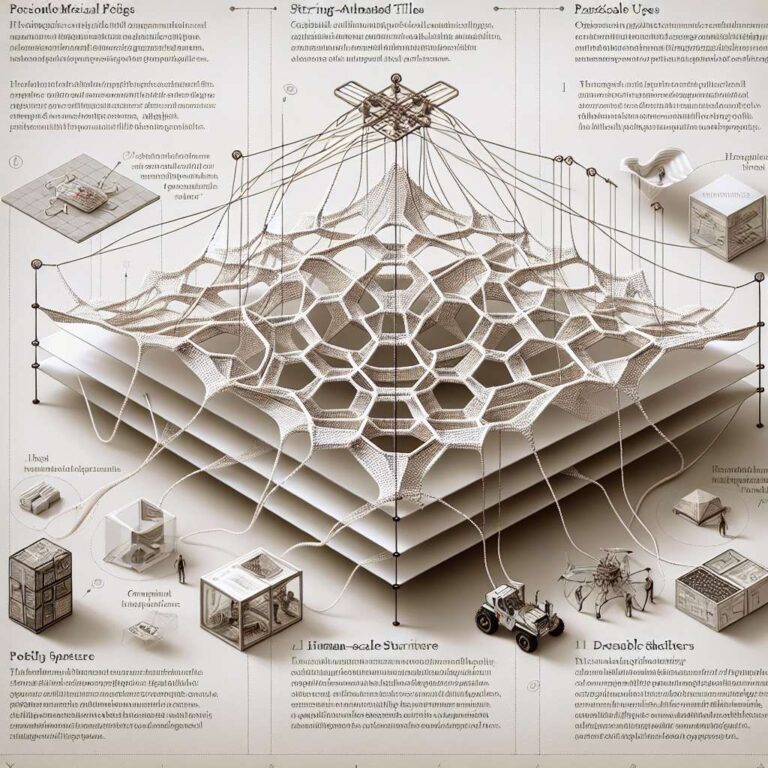
Researchers at the Massachusetts Institute of Technology have developed a method to transform flat sheets of interconnected tiles into fully formed 3D structures using a single pull of a string. Inspired by kirigami, the Japanese art of paper cutting, the team designed an algorithm that takes a user specified 3D shape and converts it into a planar tiling connected by rotating hinges at the corners. The system is intended for deployable designs such as foldable bike helmets, medical devices, emergency shelters, and field hospitals that can be transported in compact form and rapidly actuated on site.
The core of the approach is a two step algorithm that determines how a single string should be routed through the tile pattern to drive the transformation. The method computes the minimum number of points that the string must lift to create the desired shape and then finds the shortest path that connects those lift points, while including all areas of the object’s boundary that must be connected to guide the structure into its 3D configuration. These calculations are carried out so that the string path minimizes friction, enabling the structure to be smoothly actuated with just one pull. The actuation is easily reversible, allowing the structure to be flattened again, and the tile patterns can be fabricated using techniques such as 3D printing, CNC milling, or molding.
The technique aims to reduce storage volume and transportation costs for complex structures while simplifying deployment. Demonstrations range from personalized medical items like a splint and a posture corrector to an igloo like portable shelter and a human scale chair, illustrating scalability from body worn devices to furniture and architectural frames. Potential uses include transportable medical equipment, foldable robots that can flatten to navigate tight spaces, and modular space habitats that could be robotically deployed on planetary surfaces. Future work will explore designs at both very small and very large scales and pursue self deploying mechanisms so that the structures can actuate without direct human or robotic pulling.