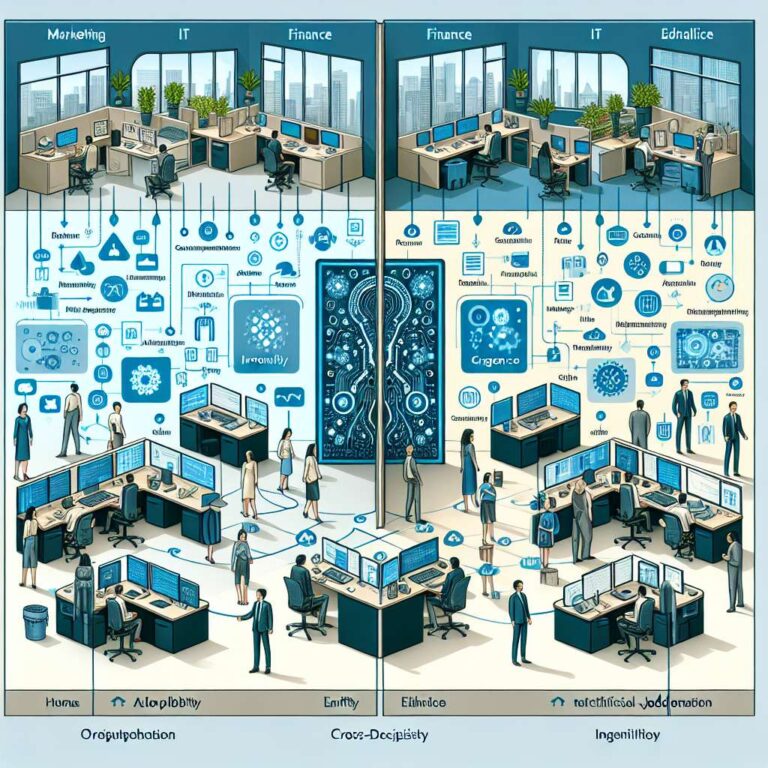
The rapid evolution of generative Artificial Intelligence is reshaping not just workplace efficiency, but the foundations of how companies are organized and how people work. Businesses are moving from using Artificial Intelligence as a supplementary tool toward becoming Artificial Intelligence-first organizations that redesign workflows, structures, and talent strategies around it from the outset. Functional hierarchies are giving way to task-oriented, workflow-based models in which humans and Artificial Intelligence agents collaborate more directly, while workers are expected to develop “reconnection capability” to link their skills and experience to shifting roles, technologies, and organizational structures.
Management is under pressure to operate faster while traditional decision-making remains slow, making autonomous Artificial Intelligence systems increasingly attractive as an operational foundation. Companies that prioritize Artificial Intelligence across their operating model are beginning to organize around end-to-end value creation rather than departmental silos. In these structures, work is assigned according to tasks, processes, and outcomes, with people and Artificial Intelligence dynamically connected to workflows. In 2025 alone, approximately 55,000 layoffs were reported as being related to Artificial Intelligence, accounting for about 4.6% of total layoffs. Examples cited include BNY Mellon, which has registered Artificial Intelligence agents as “virtual employees” in HR systems, Cosentino, which has deployed Artificial Intelligence agents in customer service and credit management, and Mitsubishi UFJ Financial Group, which is applying an “Artificial Intelligence employees” model to around twenty operational areas.
The employment outlook remains mixed as automation expands. NVIDIA’s chief executive has suggested some white-collar roles may decline while blue-collar work tied to building Artificial Intelligence infrastructure rises. Gartner estimates that the tipping point, when Artificial Intelligence-driven job creation begins to exceed job losses, may arrive around 2029, with more than 32 million jobs globally (excluding China and India) expected to be affected annually. The central challenge for companies is boosting competitiveness through Artificial Intelligence adoption while preserving employment stability, while individuals face pressure to redefine roles, update skills, and adapt to constant change.
Career development in this environment depends less on static credentials and more on continuously updated skills. Employers are placing greater weight on practical and adaptable capabilities as the half-life of knowledge shrinks. Demand is rising for Artificial Intelligence engineering and applied Artificial Intelligence skills, but also for cross-disciplinary strengths such as critical thinking, creativity, empathy, and ethical judgment. A new model is emerging in which people manage and orchestrate Artificial Intelligence agents, enabling even a single individual to handle complex work. That is helping drive interest in solopreneurs and one-person companies as viable forms of work in the Artificial Intelligence era.
Three priorities emerge for navigating the transition. Companies should build “change resilience” by adopting workflow-based structures, treating humans and digital workers as collaborators, and aligning evaluation and compensation with measurable contributions. Individuals should pair continuous learning with “reconnection capability” so they can reposition themselves as tasks and markets evolve. Governments should support practical, market-aligned reskilling, strengthen skill portability across roles and industries, and back broad-based talent development rather than focusing only on elite specialists. Competitiveness in the Artificial Intelligence era will depend on the adaptive capacity of organizations, workers, and society as a whole.