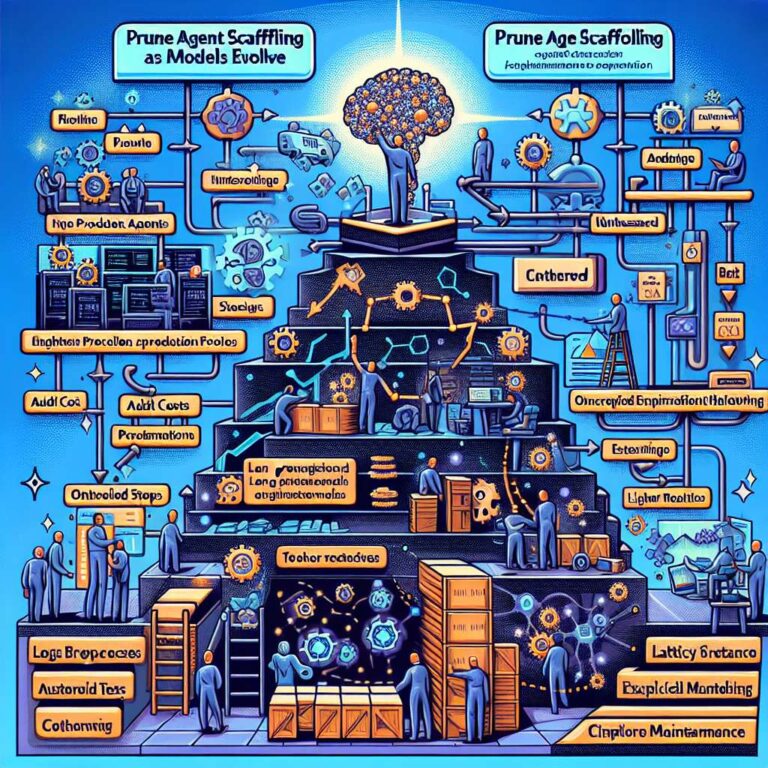
Agent scaffolding built for older models can become overhead as models improve. The article lists common symptoms of this drift: prompt bloat from accumulating system instructions, over-engineered orchestration flows, wasted tokens, slower execution due to unnecessary steps, and increased maintenance burden. Because models often evolve faster than teams remove scaffolding, this dynamic creates technical debt and inefficiency in production agents.
The proposed solution is to actively remove scaffolding as models become more capable, pushing complexity into the model rather than maintaining external orchestration. The core practice is a regular audit process: track model releases, test simplified prompts by removing instructions to see whether quality degrades, measure token usage to quantify savings, run A/B tests with and without scaffolding, and delete scaffolding that the model handles natively. The article gives a concrete example from Claude Code where a long system prompt needed for Opus 4.1 was reduced to a short directive for Sonnet 4.5 because the newer model already internalized the steps. Quotes from Boris Cherny and Cat Wu underline the expectation that scaffolding will frequently be temporary as models subsume capabilities over time.
The guidance includes practical checks and trade-offs. Look for instructions that are obvious to humans, multi-step workflows models now complete in a single turn, built-in error handling, format specifications inferred from context, and planning steps models perform internally. Benefits include reduced token costs, faster execution, simpler maintenance, future-proofing, and often better performance with less hand-holding. Downsides include the need for careful testing, version management to support multiple model configurations during transitions, reduced explicit control over internal reasoning, risk of regression if too much is removed, and potential documentation debt. Strategic recommendations are to remove scaffolding only after new models prove stable in production, start conservatively, keep domain-specific knowledge that models cannot know, and support migration paths across model versions.