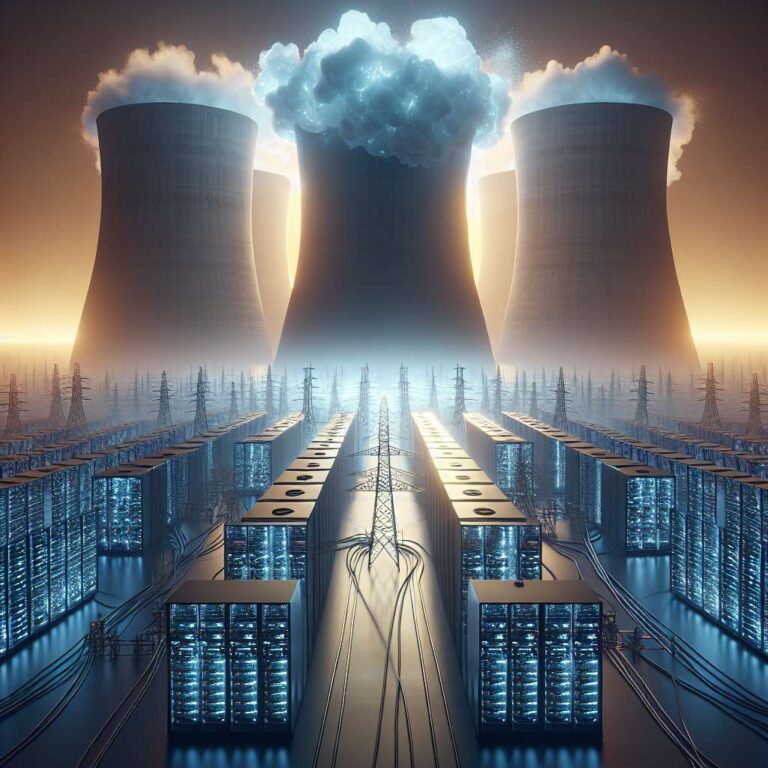
OpenAI and Nvidia announced a letter of intent to build at least 10 gigawatts of Nvidia systems to power OpenAI’s Artificial Intelligence infrastructure, with Nvidia planning to invest up to Not stated billion as the systems roll out. The companies said the first gigawatt will come online in the second half of 2026 using Nvidia’s Vera Rubin platform. Sam Altman, chief executive officer of OpenAI, framed the effort as foundational: ‘Everything starts with compute,’ and said the infrastructure will underpin future economic activity and enable new Artificial Intelligence breakthroughs at scale.
Nvidia CEO Jensen Huang told CNBC the planned deployment equals the power consumption of between 4 million and 5 million graphics processing units, matching the company’s total GPU shipments for the year and doubling last year’s volume. Huang described the effort as ‘a giant project.’ At 10 gigawatts, the buildout would require power on the order of roughly 10 nuclear reactors, since a typical reactor outputs about 1 gigawatt. By comparison, current data center facilities typically consume between 10 megawatts and 1 gigawatt, with most large centers in the 50 to 100 megawatt range. OpenAI’s proposal would therefore dwarf most existing installations and approach the electricity usage of multiple major cities.
The announcement follows OpenAI’s growth to 700 million weekly active users and prompted a near 4 percent rise in Nvidia’s stock, adding roughly Not stated billion to its market capitalization. The partnership makes Nvidia a preferred strategic compute and networking partner for OpenAI alongside existing relationships with Microsoft, Oracle, SoftBank, and partners on the Stargate project. The companies said they expect to finalize details in the coming weeks, and Huang noted the Not stated billion investment is on top of Nvidia’s existing commitments and was not included in recent investor forecasts.
The scale of the planned infrastructure has prompted comparisons to other industry moves toward nuclear and large-scale power solutions. The article cites prior agreements and purchases by other tech firms and notes International Energy Agency estimates that data centers already consumed roughly 1.5 percent of global electricity in 2024 and that global data center demand could reach 945 terawatt hours by 2030. Practical constraints such as grid bottlenecks and environmental concerns are highlighted as key challenges for any project of this magnitude.