
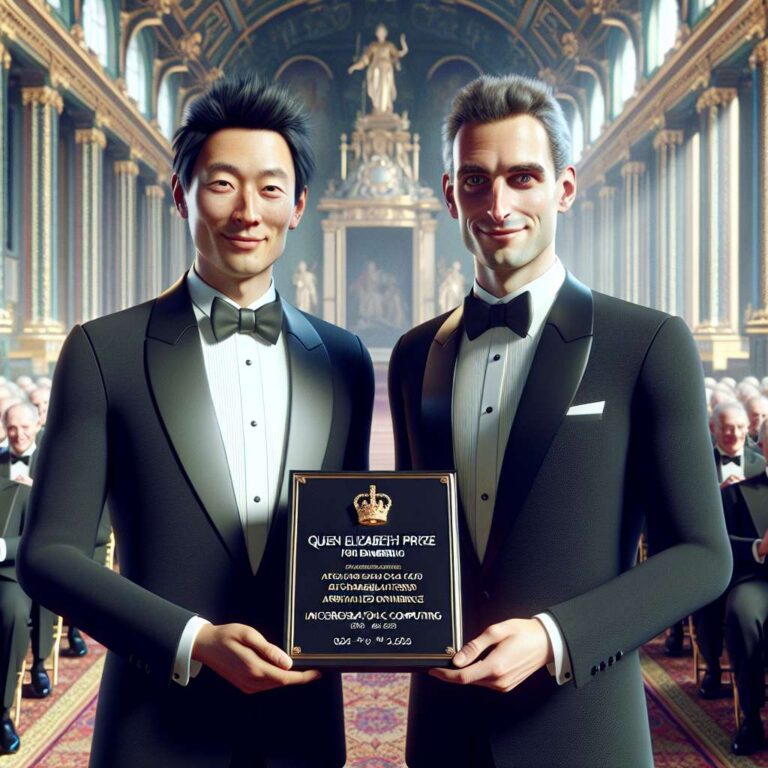
NVIDIA leaders Jensen Huang and Bill Dally awarded Queen Elizabeth Prize for Engineering for artificial intelligence

NVIDIA founder Jensen Huang and chief scientist Bill Dally were among seven recipients of the 2025 Queen Elizabeth Prize for Engineering for foundational work in artificial intelligence and accelerated computing. The award recognizes their role in developing the GPU architectures that underpin modern machine learning.

NVIDIA founder and chief executive Jensen Huang and chief scientist Bill Dally were honored with the 2025 Queen Elizabeth Prize for Engineering for foundational work in artificial intelligence and modern machine learning. The award, presented by His Majesty King Charles III at St James’s Palace, named Huang and Dally among seven laureates recognized for pioneering the GPU architectures and accelerated computing that power today’s large-scale model training and high-performance simulations.

The prize citation highlighted their leadership and vision in developing a platform that reshaped the computer industry across chips, systems, algorithms, and applications. Huang described the moment as part of a sweeping transformation in computing, equating artificial intelligence to essential infrastructure on the scale of electricity and the internet. Dally emphasized decades of progress in parallel computing and stream processing and said engineering methods continue to refine hardware and software so artificial intelligence can empower people to achieve more.

Earlier on the day of the award the pair attended a roundtable at 10 Downing Street with secretary of state for science, technology and innovation Liz Kendall and minister for science, research, innovation and nuclear Lord Patrick Vallance to discuss inspiring future engineers. The meeting marked National Engineering Day and underscored NVIDIA’s collaboration with the U.K. government, universities and industry to expand computing infrastructure, research and skills. In a separate distinction, Huang received the Professor Stephen Hawking Fellowship at the Cambridge Union, presented by Lucy Hawking, where he addressed an audience and took part in a fireside chat about advancing science and inspiring the next generation of technologists.
66

Impact Score

Siemens debuts digital twin composer for industrial metaverse deployments

Siemens has introduced digital twin composer, a software tool that builds industrial metaverse environments at scale by merging comprehensive digital twins with real-time physical data, enabling faster virtual decision making. Early deployments with PepsiCo report higher throughput, shorter design cycles and reduced capital expenditure through physics-accurate simulations and artificial intelligence driven optimization.

Cadence builds chiplet partner ecosystem for physical artificial intelligence and data center designs

Cadence has introduced a Chiplet Spec-to-Packaged Parts ecosystem aimed at simplifying chiplet design for physical artificial intelligence, data center and high performance computing workloads, backed by a roster of intellectual property and foundry partners. The program centers on a physical artificial intelligence chiplet platform and framework that integrates prevalidated components to cut risk and speed commercial deployment.

Patch notes detail split compute and IO tiles in Intel Diamond Rapids Xeon 7

Linux kernel patch notes reveal that Intel’s upcoming Diamond Rapids Xeon 7 server processors separate compute and IO tiles and adopt new performance monitoring and PCIe 6.0 support. The changes point to a more modular architecture and a streamlined product stack focused on 16-channel memory configurations.

Contact Us

Got questions? Use the form to contact us.

Contact Form

Clicking next sends a verification code to your email. After verifying, you can enter your message.