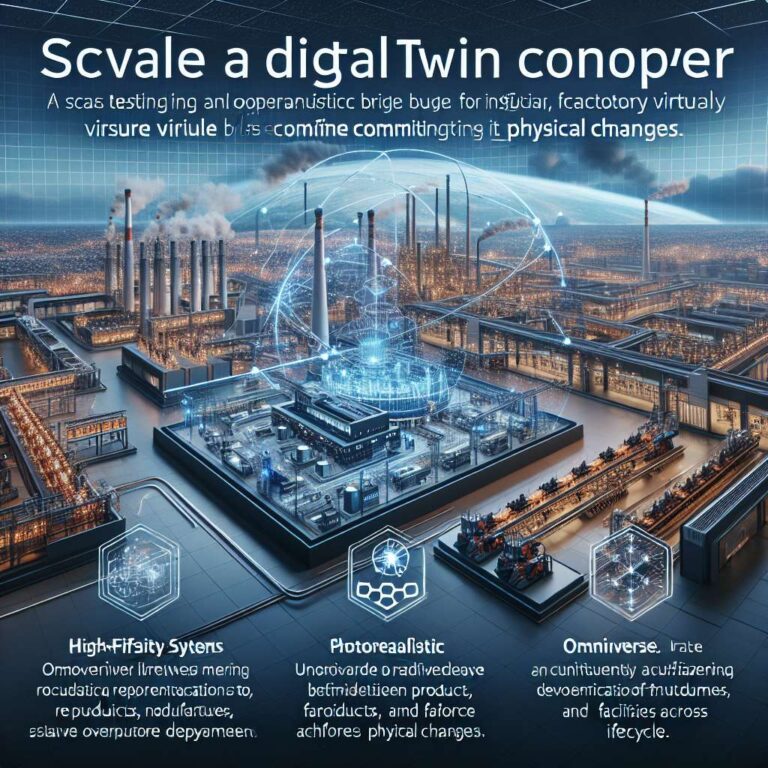
Siemens has announced digital twin composer, a software solution designed to create industrial metaverse environments at scale by combining industrial artificial intelligence, simulation and real-time physical data in a unified virtual space. The platform enables industrial companies to merge 2D and 3D data from Siemens’ comprehensive digital twin with live operational information using a managed, secure and photorealistic visual scene built on NVIDIA Omniverse libraries. By maintaining a high-fidelity 3D environment throughout the lifecycle of a product, process or facility, organizations can make decisions virtually, at speed and at scale, before committing to physical design or construction.
The system provides contextualized, real-time insights so teams can visualize, interact with and iterate on products, processes or factories in their real-world context, whether the subject is a smartphone, a tanker, an autonomous electric vehicle or a new artificial intelligence factory on a greenfield or brownfield site. PepsiCo and Siemens are using digital twin composer to digitally transform select U.S. manufacturing and warehouse facilities by converting them into high-fidelity 3D digital twins that simulate plant operations and the end-to-end supply chain to establish a performance baseline. Within weeks, teams optimized and validated new configurations to boost capacity and throughput, giving PepsiCo a unified, real-time view of operations with flexibility to integrate artificial intelligence driven capabilities over time.
By leveraging Siemens’ digital twin composer, NVIDIA Omniverse and computer vision, PepsiCo can recreate every machine, conveyor, pallet route and operator path with physics-level accuracy, enabling artificial intelligence agents to simulate, test and refine system changes, identifying up to 90 percent of potential issues before any physical modifications occur. This deployment has delivered a 20 percent increase in throughput on initial deployment and is contributing to faster design cycles, nearly 100 percent design validation and 10 to 15 percent reductions in capital expenditure (Capex). Siemens positions digital twin composer as a way to unite previously siloed design, engineering and production teams into one living, contextualized model that supports rapid testing, early automation validation and real-time operations. Integrated into the Siemens Xcelerator portfolio, the tool connects high performance, photorealistic and physically accurate digital twins to data from MES, QMS, PLCs and industrial internet of things systems, and can be extended with Siemens’ Rapidminer and other artificial intelligence software for advanced analytics. Launched at CES 2026, digital twin composer is in early access with select customers, as Siemens highlights the broader role of its Xcelerator platform and digital industries business in enabling industrial digital transformation and sustainability at global scale.