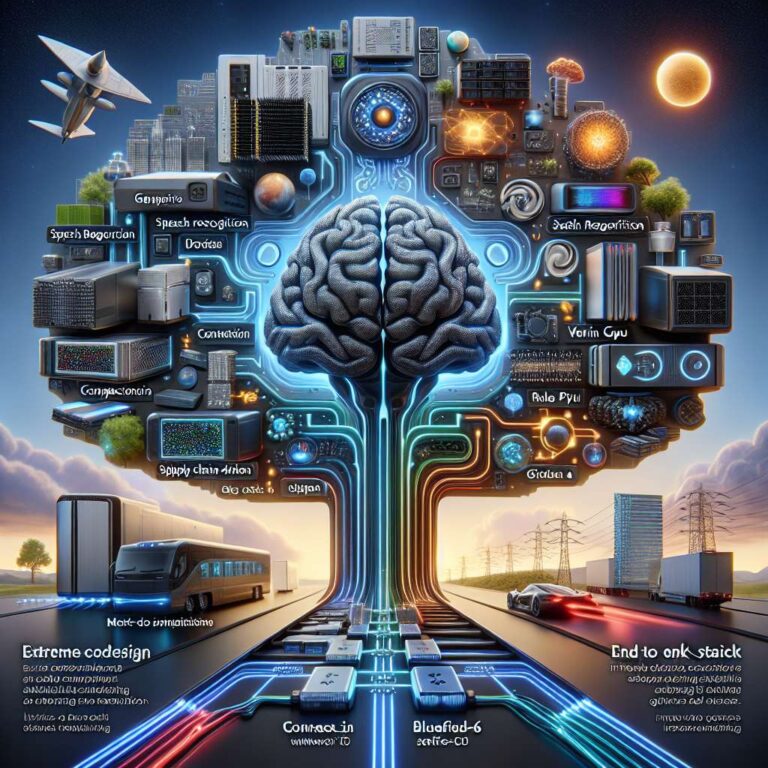
Nvidia’s corporate hub presents the company as a world leader in accelerated computing and Artificial Intelligence, highlighting how its GPUs, networking hardware, and software stacks underpin workloads from data centers to edge devices. The site emphasizes that Artificial Intelligence is powering change in every industry, citing use cases such as generative Artificial Intelligence, speech recognition, medical imaging, supply chain optimization, and data science. Across the page, Nvidia links this broad shift to its work in accelerated computing and digital twins, arguing that these technologies are transforming large industries and reshaping enterprise infrastructure.
The page aggregates current announcements and product spotlights that define Nvidia’s Artificial Intelligence strategy. In data centers, Nvidia promotes the Rubin platform with messaging that “NVIDIA Kicks Off Rubin-Six New Chips, One AI Supercomputer,” and describes how extreme codesign across the Vera CPU, Rubin GPU, NVLink 6 Switch, ConnectX-9 SuperNIC, BlueField-4 DPU, and Spectrum-6 Ethernet switch is intended to slash training time and inference token cost. For enterprise Artificial Intelligence, it surfaces DGX systems, including “Introducing NVIDIA DGX Rubin NVL8” as an Artificial Intelligence system powered by Rubin GPUs, and “NVIDIA DGX B300 is Shipping Now,” described as a purpose-built Artificial Intelligence factory infrastructure solution tailored for Artificial Intelligence reasoning and powered by Blackwell Ultra GPUs. Networking entries such as “Spectrum-6 Ethernet Switches Scale NVIDIA Rubin AI Factories” highlight how Spectrum-X Ethernet photonics switches deliver “5x improved power efficiency and uptime.”
Beyond core compute, Nvidia’s site outlines parallel pushes into automotive, robotics, simulation, and gaming. Automotive updates describe collaborations with Hyundai Motor Group, GM, Toyota, Aurora, Continental, and others to use Blackwell infrastructure, Omniverse simulation, and the Drive platform for autonomous driving, safety systems, and next-generation vehicle experiences. Robotics and edge sections center on Jetson and Isaac platforms, new Jetson Thor hardware, and Isaac GR00T foundation models, positioning these as the “ultimate platform for physical Artificial Intelligence and robotics.” Simulation and industrial digitalization content focuses on Omniverse, OpenUSD, and digital twins for factories, smart cities, and Artificial Intelligence factories, while gaming coverage underscores GeForce RTX 50 Series hardware, DLSS 4, RTX Remix, and Project G-Assist, an Artificial Intelligence assistant for PC tuning. The page also promotes upcoming events such as GTC 2026 and major keynotes by CEO Jensen Huang, reinforcing Nvidia’s role in steering the broader Artificial Intelligence ecosystem.